The technique of promoting a company, good, service, or brand via social media sites like Facebook, Instagram, YouTube, LinkedIn, and Twitter is known as social media marketing (SMM) (X).
It aids companies in building relationships with their target market, raising brand recognition, producing leads, and boosting revenue.
Main Objective
1.Boost recognition of your brand. 2.Reach out to new clients. 3.Produce sales and leads. 4.Boost traffic to your website. 5.Boost client interaction. 6.Establish a powerful internet presence.
Social Media Platform
Facebook
Instagram
YouTube
LinkedIn
Twitter (X)
Pinterest
Snapchat
Types of Social Media Marketing
1.Oragnic Social Media Marketing
Promoting a company, good, or service on social media without purchasing adverts is known as organic social media marketing.
To reach and interact with the target audience, it entails producing and disseminating free content including posts, reels, tales, videos, and updates.
Benifites:
1.Cost-Effective: No need to spend money on paid advertisements. 2.Builds Brand Awareness: Helps more people know about your brand. 3.Increases Trust: Regular and genuine content builds trust with the audience. 4.Better Customer Engagement: Allows direct interaction through comments, likes, and messages. 5.Long-Term Growth: Consistent content can create a loyal audience over time. 6.Improves Website Traffic: Social media posts can bring visitors to your website. 7.Creates Brand Loyalty: Engaging with followers encourages them to stay connected with your brand.
2.Paid Social Media Marketing
The practice of promoting a company, good, service, or brand on social media platforms by purchasing ads is known as paid social media marketing.
To reach a certain target audience based on their age, geography, hobbies, behavior, and other characteristics, businesses utilize sponsored advertisements.
Benifites:
1.Quick Results: Paid ads can immediately create visitors and leads. 2.Targeted Audience: You can target people based on their age, geography, hobbies, and behavior. 3.Increased Brand Awareness – Allows more people to discover your brand or business. 4.Higher Reach: Your material reaches a larger audience than organic posts alone. 5.Measurable Results: You may monitor clicks, impressions, conversions, and sales. 6.Budget Control – Establish a daily or total advertising budget based on your requirements. 7.More Sales and Leads – Paid advertising attracts new customers and boosts conversions. 8.Improved Customer Targeting – Advertisements can be displayed to people who are more likely to be interested in your items.
Facebook
Facebook is one of the most widely used social media platforms. It enables users to connect with friends and family, share images, videos, and posts, and communicate with one another. Facebook is also frequently used by businesses and brands for marketing, advertising, customer engagement, and creating online communities.
Main Features On Facebook
1.Profile: Personal information and identity on Facebook. 2.News Feed: Shows posts, photos, and videos from connected people and pages. 3.Friends: Connect with other users. 4.Pages: Used by businesses, brands, celebrities, and organizations. 5.Groups: Communities based on common interests. 6.Marketplace: Buy and sell products locally. 7.Messenger: Chat and communicate with others. 8.Stories and Reels: Share short-lived photos and videos.
Facebook For Digital Marketing
Businesses use Facebook to:
Build brand awareness Promote products and services Run paid advertisements Connect with customers Generate leads and sales Analyze audience performance through insights
In short, Facebook is a valuable social media tool for personal connection, entertainment, community development, and company marketing.
Instagram
Instagram is a popular social media platform for posting photos, videos, Stories, and Reels. It allows users to connect with friends, follow their favorite creators, and find new material.
Businesses and businesses use Instagram for digital marketing, brand promotion, consumer engagement, and product or service sales.
Features of Instagram
1. Profile
Users can create a personal or business profile to share information about themselves.
2. Feed
The Feed displays photos, videos, and posts from accounts you follow.
3. Stories
Stories allow users to share photos and videos that disappear after 24 hours.
4. Reels
Reels are short, entertaining videos that help increase reach and engagement.
5. Hashtags
Hashtags (#) help categorize content and make it easier for people to discover posts.
6. Direct Messages (DM)
Users can send private messages, photos, videos, and voice messages.
7. Explore
The Explore page helps users discover new content, accounts, and trends.
8. Likes and Comments
Users can interact with posts by liking and commenting.
9. Live Video
Instagram Live allows users to communicate with their audience in real time.
10. Shopping
Businesses can showcase and promote their products directly on Instagram.
Uses of Instagram in Digital Marketing
Brand Promotion: Promote products and services. Audience Engagement: Connect and communicate with customers. Reels Marketing: Create short videos to increase reach. Paid Advertising: Run targeted advertisements. Influencer Marketing: Collaborate with influencers to promote brands. Product Selling: Showcase products and attract customers. Website Traffic: Drive visitors to a website through links.
In short: Instagram is a powerful digital marketing platform for promoting brands, engaging audiences, and growing businesses online.
You Tube
YouTube is a popular video-sharing platform where users can watch, upload, share, and create videos. It is owned by Google and is one of the most widely used digital platforms in the world.
Key Features of YouTube
Video Uploading
Live Streaming
YouTube Shorts
Subscriptions
Likes and Comments
YouTube Advertising
Analytics and Insights
Monetization
Benefits of YouTube Marketing Increases brand awareness Reaches a large audience Builds customer trust Drives website traffic Generates leads and sales Supports SEO through video content
Simple Definition: YouTube is a video-sharing platform that helps people learn, entertain, connect, and promote businesses through video content.
Conclusion of Social Media Marketing
Social media marketing is an important part of digital marketing that helps businesses connect with their target audience through social media platforms. It increases brand awareness, customer engagement, website traffic, and sales.
By creating valuable content and using both organic and paid marketing strategies, businesses can build strong relationships with customers and achieve their marketing goals.
Learn Intraday Trading, day trading, intraday trading strategy, technical analysis, risk management, and practical trading factors for short-term markets.
Intraday Trading: 7 Powerful Strategies for Smarter Trading
Intraday Trading is a short-term market approach in which a position is opened and closed during the same trading session. It focuses on short-term price movements rather than holding a position for a long period. Intraday Trading requires preparation, discipline, and careful control of risk.
What Is Intraday Trading?
Intraday Trading means buying and selling a financial instrument within the same trading session. Traders may study charts, price action, news, liquidity, and volume before deciding whether to enter a position in Intraday Trading.
Day trading involves frequent decisions and short holding periods. Because prices can change quickly, traders should understand that both gains and losses can occur within a short time.
How Intraday Trading Works
A typical Intraday Trading process begins before the market opens. A trader may review the previous session, create a watchlist, identify important price levels, and define possible entry and exit points.
Technical analysis is often used to study price charts, trends, support, resistance, and momentum. It can help organize market information, but it cannot guarantee a particular result.
Intraday Trading Strategy Basics
A trading plan may focus on breakouts, trends, reversals, or range-bound movements. A trader generally defines an entry, target, and stop loss before placing an order.
A clear plan can reduce impulsive decisions. Traders should also determine how much capital they are prepared to risk before opening a position.
7 Important Factors for Intraday Trading
1. Technical Analysis
Technical analysis uses historical price and market data to study possible patterns. Traders may use moving averages, trendlines, support and resistance, and momentum indicators.
2. Trading Volume
Trading volume shows how actively a security is being bought and sold. Changes in trading volume can provide additional context when combined with price movement.
3. Market Volatility
Market volatility describes the size and speed of price changes. Higher market volatility can create larger short-term moves, but it can also increase the potential size of losses.
4. Stop Loss
A stop loss is a predefined exit level intended to limit a loss when a trade moves in an unfavorable direction. Order execution can differ depending on the order type and market conditions.
5. Risk Management
Risk management includes position sizing, maximum loss limits, and controlling total exposure. Strong risk management can help prevent one trade from creating an outsized impact on an account.
6. Trading Psychology
Fear, greed, and revenge trading can influence decisions. A written plan can help traders follow predetermined rules instead of reacting emotionally to every price movement.
7. Market News
Company announcements, economic releases, policy decisions, and global events can affect prices. Traders should verify important information through reliable sources.
Tools Used for Intraday Trading
Trading platforms can provide charts, market data, alerts, watchlists, screeners, and different order types. Technical analysis tools can help traders organize information and monitor price behavior.
Day trading platforms may also provide real-time quotes and execution features. Available products, charges, margin rules, and order types depend on the broker and market.
Benefits of Intraday Trading
Intraday Trading allows participants to focus on short-term market movements and generally close positions within the same session.
Some traders prefer not to carry positions overnight. However, frequent monitoring and repeated transactions can increase costs and decision-making pressure.
Risks of Intraday Trading
Intraday Trading involves significant financial risk. Rapid price changes can produce losses quickly, especially when margin or leveraged products are involved.
FINRA explains that frequent intraday trading can carry substantial risks, and margin trading can potentially result in losses greater than the original amount invested. Broker requirements can also differ.
Market volatility can make entries and exits harder to manage. A trader should never assume that a previous profitable trade or a particular setup will produce the same outcome in the future.
Intraday Trading Risk Management
A practical risk plan can include a predefined stop loss, controlled position size, and a maximum daily loss limit.
Risk management should be established before entering a trade. A trading journal can also help record entries, exits, mistakes, and results.
Trading volume and market volatility can be reviewed together with the overall setup. No single indicator can remove market risk.
Intraday Trading vs Long-Term Investing
Intraday Trading focuses on short-term price movements, while long-term investing generally uses a much longer holding period.
Day trading may require frequent monitoring and rapid decisions. Long-term investors may have different objectives, time horizons, and approaches to risk.
How Beginners Can Learn Intraday Trading
Beginners should first understand market basics, order types, chart reading, position sizing, and risk controls.
Before using real money, learners can study historical charts and use paper trading or other simulated practice when available. They should also understand brokerage charges and applicable rules.
An intraday trading strategy should be tested against historical or simulated conditions before being used with real capital. Past performance does not guarantee future results.
The Future of Intraday Trading
Modern technology is making market data, charting, alerts, and execution tools more accessible. Automated systems can also assist with defined trading processes.
Even advanced technology cannot remove uncertainty from financial markets. Traders still need to evaluate information, control exposure, and understand the risks of their chosen products.
Frequently Asked Questions
Is Intraday Trading profitable?
Intraday Trading can result in gains or losses. There is no guaranteed profit, and outcomes depend on market conditions, strategy, costs, execution, and risk controls.
What is the best intraday trading strategy?
There is no single strategy that works for every trader or market condition. An intraday trading strategy should have clearly defined entry, exit, and risk rules.
Is Intraday Trading risky?
Yes. Intraday Trading can involve rapid price movements and substantial losses. The risk can become higher when margin or leveraged products are used.
What is a stop loss?
A stop loss is a predefined exit instruction or price level intended to limit a loss when a trade moves against the trader.
Why is risk management important?
Risk management helps control how much capital is exposed to individual trades and can reduce the effect of a series of losing positions.
Conclusion
Intraday Trading is a fast-moving approach that requires preparation, discipline, market knowledge, and risk awareness. Traders should focus on a defined process instead of expecting guaranteed returns.
Day trading should be treated as a high-risk activity rather than a guaranteed income method. Learning technical analysis, monitoring market conditions, and applying consistent risk controls can support more informed trading decisions.
Artificial Intelligence is shaping the future of technology through AI tools, machine learning, generative AI, automation, and smarter digital experiences.
Artificial Intelligence is becoming one of the most important technologies shaping the future of digital products, businesses, education, healthcare, and everyday life. From intelligent software to advanced automation, Artificial Intelligence is helping computers understand information, identify patterns, generate content, and support complex workflows.
The future of Artificial Intelligence will not be limited to chatbots or content generators. New systems are increasingly being designed to work with multiple types of information, use external tools, and assist people with longer and more complicated tasks.
What Is the Future of Artificial Intelligence?
The future of Artificial Intelligence is focused on creating systems that can understand context, process different types of information, and perform useful tasks with appropriate human oversight.
Modern AI technology already combines data, computing power, algorithms, and machine learning to solve different problems. As these systems become more capable, businesses are exploring ways to integrate them into everyday workflows.
According to Google Cloud, modern AI includes areas such as machine learning, deep learning, natural language processing, computer vision, and generative systems.
Why Artificial Intelligence Matters for the Future
Artificial Intelligence can process large amounts of information quickly and identify patterns that may be difficult to find manually. This makes the technology useful for research, customer service, software development, marketing, education, and many other areas.
The future will also involve closer cooperation between people and intelligent software rather than simply replacing existing digital tools.
7 Major Artificial Intelligence Trends to Watch
The next stage of Artificial Intelligence is developing across several connected areas. These trends can influence how businesses build software and how people interact with technology.
1. Generative AI Will Continue to Grow
Generative AI can create text, images, audio, video, and computer code from user instructions. Its rapid development has already changed how people approach content creation, research, design, and software development.
Future generative AI systems may become better at understanding context and working across multiple formats. Multimodal systems can process combinations of text, images, audio, and video.
This development can make AI tools more useful for people who need to work with different types of information.
2. AI Agents Will Handle Complex Workflows
One important direction for Artificial Intelligence is the development of AI agents. Instead of simply responding to one prompt, an agent can be designed to complete multiple steps toward a specific goal.
For example, an AI agent could gather information, organize data, use software tools, create a draft, and request human approval before completing an important action.
This approach can make AI automation more useful for businesses with repetitive multi-step processes.
3. Machine Learning Will Become More Specialized
Machine learning will remain a core technology behind many intelligent systems. Instead of using one model for every possible task, organizations may increasingly use specialized models designed for particular industries and workflows.
Specialized machine learning systems can be trained or adapted for areas such as customer service, financial analysis, manufacturing, education, and scientific research.
Better data management and model evaluation will remain important because the quality of training data can affect system performance.
4. AI Will Become More Multimodal
Future AI systems are expected to work with several types of information at the same time.
A system could potentially analyze a document, understand an image, process spoken instructions, and generate a response in one workflow.
Deep learning has played an important role in the development of systems that can process complex patterns across different types of data.
5. Natural Language Processing Will Improve
Natural language processing allows computers to understand, interpret, and generate human language.
Future systems may become better at understanding context, maintaining conversations, translating languages, summarizing information, and responding to more complicated instructions.
Improved natural language processing can make software easier to use because people can interact with digital systems using everyday language instead of learning complicated commands.
6. AI Automation Will Transform Business Workflows
AI automation combines intelligent systems with automated processes. Businesses can use it for document processing, customer support, data entry, reporting, research, and workflow management.
Instead of automating only one simple task, organizations can connect multiple steps into a single workflow.
Human review can remain important for sensitive or high-impact decisions. Google Cloud documentation also highlights the value of considering human involvement at critical stages when developing automated generative AI workflows.
7. AI Will Become More Accessible
Another important trend is accessibility. AI technology is becoming easier for businesses, developers, students, and individual users to experiment with.
AI technology tools are increasingly available through websites, mobile applications, APIs, cloud platforms, and productivity software.
As access expands, understanding how to use AI responsibly will become just as important as understanding the technology itself.
How Artificial Intelligence Can Change Businesses
Artificial Intelligence can influence business operations in several ways.
Companies can use AI applications to analyze customer feedback, generate content ideas, improve support services, identify patterns in data, and automate repetitive processes.
For example, a business could use AI tools to summarize customer conversations and identify frequently reported problems. Employees could then use those insights to improve products or services.
The future of business AI is likely to involve a combination of automation and human decision-making.
Artificial Intelligence in Everyday Life
People already interact with Artificial Intelligence through search engines, recommendation systems, navigation applications, spam filters, voice assistants, and other digital services.
In the future, these systems may become more personalized and context-aware.
For example, an intelligent assistant could help organize information from different applications, summarize important messages, prepare a task list, and provide suggestions based on a user’s instructions.
The goal would be to reduce repetitive digital work while keeping users in control of important decisions.
The Role of AI Tools in the Future
AI tools are likely to become more integrated into everyday software.
Writers may use them for research and drafting. Developers may use them for coding assistance and debugging. Designers may use them for concept development. Businesses may use them for analysis and workflow management.
However, users should still verify important information generated by AI systems. AI outputs can contain errors, and the quality of a result depends on the model, instructions, available data, and specific use case.
Challenges in the Future of Artificial Intelligence
The growth of Artificial Intelligence also creates important challenges.
Privacy, cybersecurity, misinformation, bias, copyright, reliability, and responsible deployment all require attention.
Deep learning models can be complex, and it may not always be easy to understand why a particular output was produced.
Organizations should therefore establish appropriate testing, monitoring, security, and human-review processes before deploying AI systems in important workflows.
Skills Needed for an AI-Powered Future
People do not necessarily need to become AI researchers to work effectively with Artificial Intelligence.
Useful skills can include understanding how AI systems work, writing clear instructions, checking AI-generated information, working with data, and understanding the limitations of automated systems.
For developers, knowledge of APIs, machine learning concepts, data handling, and software engineering can be valuable.
For business professionals, understanding AI applications and workflow design can help identify practical opportunities.
What Could Artificial Intelligence Look Like in the Future?
The next generation of Artificial Intelligence may combine reasoning, multimodal processing, tool use, memory, automation, and interaction with physical devices.
Microsoft Research’s 2026 research outlook discusses developments involving AI agents, reasoning, robotics, multimodal systems, AI infrastructure, and longer-running workflows.
These developments suggest that future AI systems may increasingly operate as collaborators within digital workflows rather than simply responding to isolated questions.
However, the exact capabilities and timeline of future systems remain uncertain because research and deployment are developing rapidly.
Frequently Asked Questions
What Is the Future of Artificial Intelligence?
The future of Artificial Intelligence is expected to include more capable generative systems, AI agents, multimodal models, specialized machine learning, and advanced automation.
Will AI Tools Become More Powerful?
AI tools are continuing to develop across writing, coding, research, design, analysis, and productivity. Their usefulness will depend on the specific task, data, model, and human oversight.
How Will AI Applications Affect Businesses?
AI applications can help businesses automate repetitive work, analyze information, improve customer experiences, and support employees with complex workflows.
Why Is Machine Learning Important?
Machine learning allows computer systems to learn patterns from data and use those patterns for predictions, classifications, and other tasks. It remains an important foundation of modern AI systems.
What Is Generative AI?
Generative AI is a type of technology that can create new content such as text, images, audio, video, and code based on user instructions.
Conclusion
Artificial Intelligence is moving beyond simple automation and basic digital assistance. The combination of generative AI, machine learning, deep learning, natural language processing, AI agents, and AI automation is creating new ways for people and businesses to interact with technology.
The future will likely depend not only on more capable AI systems but also on responsible implementation, reliable information, security, privacy, and human oversight.
Understanding these developments today can help businesses, developers, students, and everyday users prepare for an increasingly AI-powered digital world.
Explore Artificial Intelligence, AI technology, machine learning, AI tools, generative AI, and real-world AI applications shaping the future.
Artificial Intelligence: How AI Is Changing the Modern World
Artificial Intelligence is transforming the way people work, communicate, learn, and use digital services. From smart assistants to advanced business software, Artificial Intelligence is becoming an important part of modern technology.
What Is Artificial Intelligence?
Artificial Intelligence refers to computer systems that can perform tasks that normally require human intelligence. These tasks include learning, recognizing patterns, understanding language, analyzing information, and generating useful results.
The growth of Artificial Intelligence has been supported by better computing power, large datasets, and advanced algorithms.
How Artificial Intelligence Technology Works
AI technology combines data, algorithms, and computing systems to process information and generate results. Different systems can analyze text, images, audio, numbers, and other forms of data.
Machine learning allows these systems to identify patterns from data and improve their performance for specific tasks.
Machine Learning in Artificial Intelligence
Machine learning is one of the most important technologies used in Artificial Intelligence. It enables computers to learn from data and make predictions or classifications without relying entirely on manually programmed rules.
Deep learning is an advanced form of machine learning that uses neural networks to process complex information.
Deep Learning and Artificial Intelligence
Deep learning can process large and complicated datasets using multiple layers of neural networks. It is used in image recognition, speech processing, recommendation systems, and other advanced applications.
AI Tools and Artificial Intelligence
Modern AI tools are available for writing, research, coding, design, customer service, data analysis, and productivity.
Businesses and individuals can use AI tools to save time, organize information, generate ideas, and support repetitive workflows.
AI Tools for Business
Businesses can use AI tools for customer support, data analysis, content creation, research, and workflow management.
AI technology can also help organizations identify patterns in large datasets and support human decision-making.
Artificial Intelligence Applications in Different Industries
Artificial Intelligence is being used across healthcare, education, finance, marketing, manufacturing, transportation, and software development.
AI Applications in Healthcare
AI applications can support medical research, medical-image analysis, data processing, and administrative workflows.
AI Applications in Education
Educational organizations can use AI applications for personalized learning, content development, student assistance, and administrative tasks.
AI Applications in Marketing
Marketing professionals use AI technology to analyze audiences, create content ideas, personalize experiences, and improve marketing workflows.
Generative AI and Artificial Intelligence
Generative AI is a rapidly developing area of Artificial Intelligence that can create text, images, audio, video, and computer code from user instructions.
Generative AI has made content creation and experimentation more accessible to creators, developers, students, and businesses.
Natural Language Processing and Artificial Intelligence
Natural language processing enables computers to understand, analyze, and generate human language.
It is used in chatbots, translation systems, voice assistants, search systems, and conversational software.
AI Automation and Artificial Intelligence
AI automation combines intelligent software with automated workflows to reduce repetitive manual tasks.
Organizations can use AI automation for customer support, document processing, data management, and other business operations.
AI automation can improve workflow efficiency while allowing humans to review important decisions and results.
Benefits of Artificial Intelligence
Artificial Intelligence can process large amounts of information quickly and help identify patterns that may be difficult to find manually.
Automation can reduce repetitive work and allow employees to focus on creative, strategic, and human-centered activities.
Artificial Intelligence can also support personalization by analyzing user behavior and generating relevant recommendations.
Challenges of Artificial Intelligence
Artificial Intelligence also has limitations. Systems may generate inaccurate information, depend on the quality of their training data, or create concerns related to privacy, security, transparency, and bias.
Deep learning models can be complex, making some AI-generated results difficult to explain.
Responsible use requires testing, monitoring, appropriate data protection, and human oversight.
The Future of Artificial Intelligence
The future of Artificial Intelligence will involve continued development of intelligent software, generative AI, machine learning, and advanced automation.
Natural language processing will continue to influence how people communicate with software through conversational interfaces.
As Artificial Intelligence becomes more accessible, understanding its capabilities and limitations will become increasingly important.
Frequently Asked Questions
What Is Artificial Intelligence?
Artificial Intelligence is a field of computer science focused on creating systems capable of performing tasks involving learning, reasoning, language understanding, pattern recognition, and prediction.
What Are AI Applications?
AI applications include healthcare systems, educational platforms, recommendation engines, customer-service software, marketing platforms, data-analysis systems, and development tools.
What Are AI Tools Used For?
AI tools can help with writing, research, coding, design, data analysis, customer service, content creation, and workflow automation.
What Is Generative AI?
Generative AI refers to systems that can create new text, images, audio, video, or code based on instructions provided by users.
What Is Natural Language Processing?
Natural language processing is a technology that enables computers to understand, analyze, and generate human language.
Conclusion
Artificial Intelligence is becoming a major part of modern digital technology. Its combination with machine learning, deep learning, natural language processing, generative AI, and automation is creating new possibilities across many industries.
Organizations can benefit from these technologies while maintaining responsible data practices, human oversight, and appropriate evaluation of AI-generated results.
Facebook Meta Ads are paid advertisements created by businesses, organizations, creators, and individuals to promote their products, services, websites, apps, or content to a specific audience. Meta Ads are mainly managed through Meta Ads Manager and can appear across platforms owned by Meta, including Facebook and Instagram.
Facebook advertising has become an important part of digital marketing because it allows businesses to reach people based on factors such as age, location, interests, online behavior, and demographics. Instead of showing an advertisement to everyone, businesses can target people who are more likely to be interested in their products or services.
What Are Meta Ads?
Meta Ads are online advertisements provided by Meta Platforms. They allow advertisers to create campaigns and display promotional content to selected audiences. Although people commonly call them “Facebook Ads,” the advertising system now covers multiple Meta platforms and placements.
An advertisement can contain different types of content, such as
Images
Videos
Text
Carousels
Product collections
Stories
Reels
Links to websites
Lead-generation forms
For example, a clothing business can create an advertisement showing its latest collection and target people who may be interested in fashion. A local car dealership can use Meta Ads to promote available cars to people within a particular city or surrounding area.
How Do Facebook Meta Ads Work?
Meta Ads work through an advertising system in which advertisers choose their campaign objective, audience, budget, advertisement format, and placements. Meta then delivers the advertisement to people who are more likely to take the desired action.
The basic process is
Business → Create Campaign → Select Objective → Choose Audience → Set Budget → Create Ad → Meta Delivers Ad → Measure Results
1. Choose a Campaign Objective
The first step is deciding what the business wants to achieve. Common objectives include:
Increasing brand awareness
Getting website visitors
Generating leads
Increasing engagement
Promoting an app
Increasing sales
Choosing the right objective helps businesses measure whether the advertising campaign is successful.
2. Select the Target Audience
One of the major advantages of Meta Ads is audience targeting. Advertisers can select audiences using different characteristics, such as
Age group
Location
Interests
Demographics
Online activities
Previous interactions with a business
Businesses can also create Custom Audiences from people who have previously interacted with their business and Lookalike Audiences to reach people who have characteristics similar to an existing audience.
3. Set the Budget
Advertisers decide how much money they want to spend. A campaign can have a daily budget or a budget for a specific period.
The cost of advertising depends on factors such as audience, competition, campaign objective, advertisement quality, and market conditions. Businesses should start with a budget they can afford and monitor the results before increasing spending.
4. Create the Advertisement
The next step is creating the actual advertisement. A good Meta ad generally includes an attractive visual, a clear message, relevant information, and a suitable call to action (CTA).
Examples of CTAs include:
Learn More
Shop Now
Contact Us
Sign Up
Get Quote
Book Now
5. Select Ad Placements
Meta Ads can appear in different locations across Meta’s platforms. Depending on the campaign and settings, advertisements can appear in areas such as Facebook and Instagram feeds, Stories, and Reels.
Meta’s automated placement options can help distribute advertisements across available placements based on campaign settings.
Types of Meta Ads
There are several common formats of Meta Ads.
1. Image Ads
Image ads use a single picture with text and other advertising elements. They are simple and useful for promoting products, services, offers, or events.
2. Video Ads
Video ads use video content to communicate a message. They can be useful for product demonstrations, tutorials, business introductions, and promotional campaigns.
3. Carousel Ads
Carousel ads allow advertisers to display multiple images or videos within one advertisement. Users can move through the different cards. This format is useful when a business wants to show several products or explain multiple features.
4. Stories and Reels Ads
Stories and Reels provide vertical, mobile-friendly advertising formats. Businesses can use short videos, images, text, and calls to action to attract attention.
5. Lead Ads
Lead ads are designed to collect information from interested customers, such as their name, phone number, or email address. They can be useful for businesses that want inquiries or potential customers.
6. Shopping and Product Ads
Businesses can use product-focused advertising to showcase products and encourage people to learn more or make purchases, depending on the available commerce features and campaign setup.
Benefits of Facebook Meta Ads
Meta Ads provide several benefits to businesses.
1. Large Audience
Facebook and Instagram have large user bases, giving businesses opportunities to reach many potential customers.
2. Targeted Advertising
Businesses can target specific audiences rather than showing advertisements randomly. This can make advertising more relevant.
3. Budget Flexibility
Businesses can control their advertising budgets and adjust campaigns according to their goals and performance.
4. Measurable Results
Meta provides performance information that can help advertisers understand how their campaigns are performing. Important metrics can include impressions, reach, clicks, engagement, leads, conversions, and cost per result.
5. Brand Awareness
Meta Ads can help new and established businesses introduce their brands to potential customers.
6. Lead Generation
Businesses can use advertising campaigns to generate inquiries and collect potential customer information.
7. Website Traffic
Ads can direct interested users to a website, landing page, online store, or other destination.
Important Meta Ads Metrics
Measuring performance is an important part of advertising. Some common metrics include
Reach: Number of people who saw the advertisement.
Impressions: Number of times the advertisement was displayed.
Clicks: Number of times users clicked the advertisement.
CTR: Percentage of people who clicked after seeing the advertisement.
CPC: Cost paid for each click.
CPM: Cost for 1,000 impressions.
Conversions: Desired actions completed by users.
Cost per Result: Average amount spent to achieve the selected result.
These metrics help advertisers identify which campaigns, audiences, and advertisements are performing well.
Tips for Successful Meta Advertising
To create effective Meta Ads, businesses should use clear and attractive visuals, write simple advertising messages, select a relevant audience, use an appropriate CTA, and regularly monitor campaign performance.
Testing different advertisements can also be useful. For example, a business might test two different images or messages to see which one produces better results. This process is commonly known as A/B testing.
Businesses should also make sure that advertisements provide accurate information and lead users to a useful destination.
An awareness campaign is a type of advertising campaign designed to help a business, brand, product, service, or organization become known to more people. In Meta Ads, an Awareness campaign can be used across platforms such as Facebook and Instagram to introduce a brand to a relevant audience and increase recognition. The main purpose is not necessarily to generate an immediate sale, but to make more people familiar with the business and what it offers.
Awareness is especially useful for businesses that are new to the market, launching a new product, entering a new location, or trying to build a stronger presence online. When people repeatedly see useful and relevant content from a business, they may become more familiar with the brand and remember it when they later need its products or services.
What Is an Awareness Campaign?
An Awareness Campaign is a paid advertising campaign focused on reaching and informing a target audience. Instead of primarily asking people to purchase something immediately, the campaign introduces the business and communicates its value.
For example, imagine a new clothing brand starts selling products online. The company could run an Awareness campaign showing its brand name, clothing collections, designs, and unique features to people who may be interested in fashion. The purpose is to introduce the brand and create recognition.
In Meta Ads Manager, the Awareness objective is one of the campaign objectives available to advertisers. The specific optimization and performance options can vary as Meta updates its advertising system.
Main Purpose of an Awareness Campaign
The major purpose of an Awareness campaign is to increase brand recognition and reach the appropriate audience.
Some common purposes include:
Introducing a new business
Promoting a new product
Increasing brand recognition
Reaching a new audience
Supporting a product launch
Building familiarity with a business
Promoting an event or service
Communicating important information
Increasing visibility on Facebook and Instagram
Supporting long-term marketing activities
An Awareness campaign can therefore be an important part of the early stages of a customer’s journey.
How Does an Awareness Campaign Work?
An Awareness campaign generally follows several steps.
Step 1: Set the campaign objective
The advertiser selects Awareness as the campaign objective in Meta Ads Manager.
Step 2: Define the target audience.
The advertiser determines who should see the advertisements. Depending on the campaign setup, audience signals can include factors such as location, age, interests, and other available targeting options.
Step 3: Set the budget.
The advertiser chooses how much money to spend. A budget can be established according to the business’s advertising plan.
Step 4: Create the advertisement.
The business creates the content that people will see. This could include an image, video, carousel, headline, primary text, and other creative elements.
Step 5: Select placements
Meta advertisements can appear in different environments across its platforms, depending on the campaign and available placement options. These can include Facebook and Instagram surfaces such as Feed, Stories, and Reels.
Step 6: Launch and monitor
After checking the campaign, the advertiser publishes it and monitors its performance. The campaign can then be adjusted based on the results.
Important Elements of an Awareness Campaign
A successful Awareness campaign usually contains several important elements.
1. Target Audience
The audience is the group of people the business wants to reach. Understanding the audience helps the advertiser create more relevant messages.
For example, a local restaurant might want to reach people in its service area rather than people in another state.
2. Creative Content
Creative content is one of the most visible parts of an advertisement. It can include:
Images
Videos
Carousels
Graphics
Brand logos
Product demonstrations
Educational content
Good creative should communicate the main idea clearly and quickly.
3. Ad Copy
Ad copy is the written message used in an advertisement. It should explain what the business offers and why the audience may find it useful.
For example:
“Discover affordable digital marketing solutions designed to help small businesses build their online presence.”
4. Brand Identity
The advertisement should clearly represent the business. Brand elements can include:
Business name
Logo
Brand style
Product presentation
Consistent messaging
Consistent branding can help people recognize the business across different advertisements.
5. Budget
Budget determines how much the advertiser is prepared to spend. A business should establish its budget according to its goals and available resources.
Types of Content Used in Awareness Campaigns
Different types of content can be used depending on the business.
Educational content: Explains a topic or teaches the audience something useful.
Product introduction: Introduces a new product and explains its features.
Brand story: Tells people about the business and what it represents.
Video demonstration: Shows how a product or service works.
Customer-focused content: Explains how the business addresses a customer need.
Event promotion: Creates awareness about an upcoming event or activity.
Repeated exposure can help people become familiar with a business name, product, or service.
2. Reaches New People
Awareness advertising can help a business introduce itself to people who may not have encountered the brand previously.
3. Supports Product Launches
When a company introduces a new product, an Awareness campaign can help communicate the launch to a relevant audience.
4. Increases Online Visibility
Advertising can help increase the visibility of a business across Meta platforms.
5. Supports Long-Term Marketing
Awareness can be an early stage of a broader marketing strategy. People who become familiar with a business may later interact with other marketing campaigns.
6. Communicates Brand Values
Businesses can use Awareness campaigns to explain their mission, products, services, or unique characteristics.
Awareness Campaign vs. Sales Campaign
An Awareness campaign and a Sales campaign have different primary purposes.
Awareness Campaign
Sales Campaign
Builds awareness
Encourages sales
Focuses on reaching relevant people
Focuses on conversion actions
Introduces a brand or product
Promotes a purchase or conversion
Useful for new brands
Useful for businesses seeking purchases
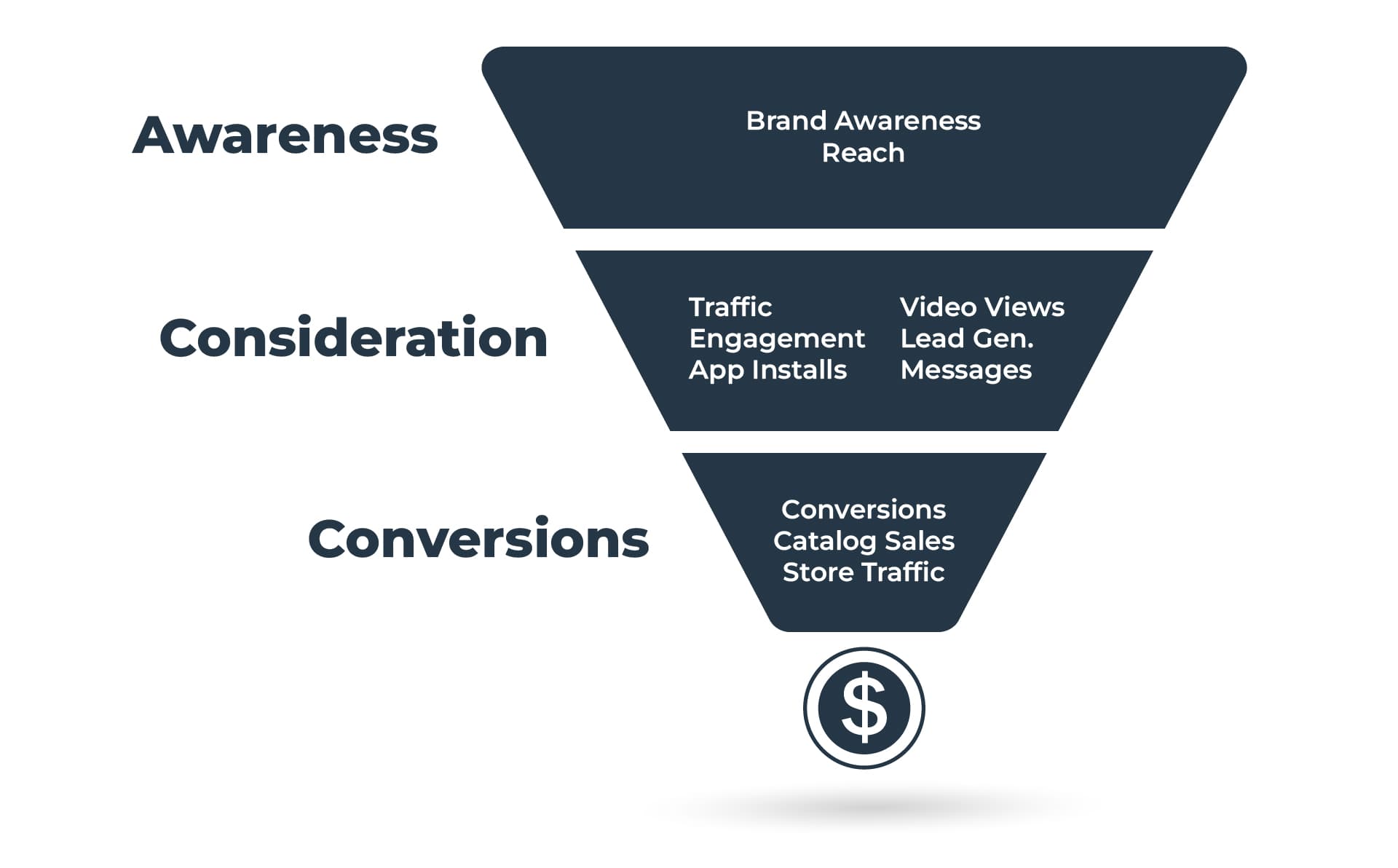
Often supports the upper funnel
Usually focuses further down the customer journey
Neither campaign exists in isolation. Businesses may use different campaign objectives at different stages of their overall marketing strategy.
Measuring an Awareness Campaign
Advertisers should monitor appropriate performance metrics to understand how the campaign is performing. Depending on the campaign setup, useful measurements may include:
Reach
Impressions
Frequency
Video views
Cost per result
Amount spent
Engagement-related measurements
Brand-related performance measurements where available
Reach indicates the number of people who were shown the advertisement.
Impressions represent the number of times advertisements were displayed.
Frequency helps indicate how often people were exposed to advertisements on average.
These measurements can help advertisers understand how widely the campaign was delivered and whether the campaign is achieving its intended purpose.
Example of an Awareness Campaign
Suppose SK Mobile wants to introduce its mobile-phone business to more people in its local market.
The campaign could be structured like this:
Campaign Objective: Awareness Business: SK Mobile Audience: People in the business’s target service area Creative: Smartphone images or a short product video Message: Introduce SK Mobile and its available products and services CTA: Learn More Placements: Suitable Facebook and Instagram placements Goal: Increase awareness of SK Mobile
The advertisement might show the business name, products, services, location information, and a simple message that makes the business easy to remember.
Best Practices for Awareness Campaigns
To create an effective Awareness campaign, businesses should consider the following practices:
Know your audience—understand who you want to reach.
Use clear messaging—communicate one main idea.
Use high-quality creative – Images and videos should represent the business clearly.
Show your brand – Make the business identity easy to recognize.
Keep the message simple – Avoid unnecessary information.
Use relevant content – Match the advertisement to the audience.
Test different creatives – Compare different images, videos, and messages.
Discover Artificial Intelligence, AI technology, machine learning, AI tools, generative AI, and real-world applications transforming modern businesses and everyday life.
Artificial Intelligence: How It Is Transforming the Digital World
Artificial Intelligence is changing the way people work, communicate, learn, and use digital services. From intelligent search systems to business software, modern AI can help organizations process information, automate repetitive tasks, and create new digital experiences.
What Is Artificial Intelligence?
Artificial Intelligence refers to computer systems that are designed to perform tasks associated with human intelligence. These tasks can include understanding language, recognizing patterns, analyzing information, generating content, and making predictions.
The development of AI has expanded rapidly because of improvements in computing power, data availability, and advanced algorithms.
How Does AI Technology Work?
AI technology uses algorithms and data to analyze information and produce useful outputs. Depending on the system, it can work with text, images, audio, numbers, or other types of information.
Machine learning is an important part of modern AI systems because it allows computers to identify patterns from data and improve their performance over time.
Major Technologies Behind AI
Several technologies contribute to the development of AI. Together, they allow computers to process information, understand patterns, and perform increasingly complex tasks.
Machine Learning
Machine learning allows software to learn from data instead of relying entirely on manually written rules. It is used for recommendations, predictions, fraud detection, classification, and many other tasks.
Deep learning is an advanced approach within machine learning that uses multi-layer neural networks to process complex information. It has contributed to major improvements in image recognition, speech systems, and other AI capabilities.
Natural Language Processing
Natural language processing helps computers understand and generate human language. It is used in chatbots, translation systems, voice assistants, search engines, and text-analysis software.
Natural language processing has become particularly important as more people interact with computers through conversational interfaces.
Popular AI Tools and Their Uses
Today, AI tools are available for writing, research, coding, design, customer service, data analysis, and productivity. These tools can assist users with tasks that previously required significant amounts of manual work.
AI Tools for Businesses
Businesses can use AI to analyze customer information, generate content ideas, summarize documents, and support customer-service workflows.
AI technology can also help companies identify patterns in large datasets and provide information that supports human decision-making.
Real-World AI Applications
The practical use of AI extends across many industries. Organizations are using intelligent systems to improve workflows, analyze information, and develop new services.
AI in Healthcare
AI applications can assist with medical research, medical-image analysis, data processing, and administrative workflows. These systems are generally intended to support qualified professionals rather than replace their judgment.
AI in Education
Educational organizations can use AI for personalized learning, content creation, student assistance, and administrative tasks.
AI in Marketing
Marketing teams use AI to analyze audiences, generate ideas, personalize experiences, and improve digital campaigns.
Generative AI and Content Creation
Generative AI can create new content such as text, images, audio, video, and computer code based on instructions provided by users.
The growth of AI has made content creation and experimentation more accessible to individuals, creators, developers, and businesses.
AI Automation
AI automation combines intelligent software with automated workflows to reduce repetitive manual tasks. It can be used for customer support, data processing, document handling, and business operations.
Organizations can use AI automation to streamline workflows while keeping human review for tasks that require judgment.
Benefits of Artificial Intelligence
Artificial Intelligence can help organizations process large quantities of information quickly and identify patterns that may be difficult to detect manually.
Another benefit is automation. Repetitive activities can be handled by software, allowing people to spend more time on creative, strategic, and interpersonal work.
Artificial Intelligence can also support personalization by analyzing user behavior and providing more relevant recommendations and experiences.
Challenges of AI
Despite its benefits, Artificial Intelligence has limitations. AI systems can produce incorrect results, depend on the quality of available data, and create concerns related to privacy, security, transparency, and bias.
Deep learning systems can also be difficult to explain because their internal decision-making processes may involve complex mathematical models.
Responsible development therefore requires testing, monitoring, appropriate data practices, and human oversight.
The Future of Artificial Intelligence
The future of AI will involve continued development of intelligent software, advanced automation, generative systems, and data-driven applications.
Machine learning will remain an important area as organizations look for ways to analyze data and improve digital products.
Natural language processing will also continue to influence how people communicate with software through conversational interfaces.
As AI becomes more accessible, users will need to understand both its capabilities and its limitations.
Frequently Asked Questions
What is Artificial Intelligence?
Artificial Intelligence is a field of computer science focused on creating systems that can perform tasks involving learning, reasoning, language understanding, pattern recognition, and prediction.
What are the main AI applications?
Common AI applications include healthcare systems, educational platforms, recommendation engines, customer-service solutions, marketing tools, data analysis, and software development.
What is generative AI?
Generative AI refers to systems that can produce new content such as text, images, audio, video, or code based on user instructions.
What is natural language processing?
Natural language processing is a technology that enables computers to understand, analyze, and generate human language.
Conclusion
Artificial Intelligence is becoming an important part of modern digital technology. Its combination with machine learning, deep learning, natural language processing and automation is creating new possibilities across different industries.
Businesses and individuals can benefit from understanding these technologies while maintaining appropriate human oversight and responsible data practices.
Learn how to get backlinks with 10 easy and effective strategies. Discover how to build quality backlinks, improve SEO, and increase website traffic.
If you want to increase your website traffic and improve your search engine rankings, learning how to get backlinks is an important part of SEO. Backlinks are links from other websites that point to your website. They help search engines understand that your content may be useful and trustworthy.
For beginners, building backlinks can seem difficult. You may wonder where to find backlink opportunities, how to contact website owners, or whether you need to spend money to get links. The good news is that there are several simple ways to build backlinks, even if you have a new website.
In this guide, you will learn how to get backlinks using 10 effective strategies. We will also explain what makes a backlink valuable, how to build links naturally, and common mistakes to avoid.
What Are Backlinks?
Backlinks are links from one website to another website. For example, imagine you write a blog about SEO for beginners. Another website finds your article useful and adds a link to it in one of its blog posts. That link is called a backlink.
Backlinks are also known as inbound links or incoming links.
Search engines use links as one part of understanding websites and their content. A relevant, editorially placed link from a trustworthy website can be a useful signal of credibility.
However, not every backlink has the same value. A link from a relevant, trusted website may be more useful than a link from an unrelated or low-quality website.
Example of a backlink
Suppose you have a website called MySEOGuide and publish an article titled “Keyword Research for Beginners.”
A digital marketing website writes an article about SEO tools and links to your keyword research guide.
That link is a backlink to your website.
Why Are Backlinks Important for SEO?
Backlinks are an important part of off-page SEO. They can help search engines discover pages, understand relationships between websites, and evaluate signals of authority.
Here are some important benefits of backlinks.
1. Improve Website Authority
When relevant and trustworthy websites link to your content, it can support your website’s credibility. This does not guarantee higher rankings, but quality backlinks can contribute to a stronger SEO profile.
2. Increase Referral Traffic
Backlinks can bring visitors directly from another website. If someone clicks a link in a blog post and visits your website, that is called referral traffic.
For example, if a popular marketing blog links to your SEO guide, interested readers may visit your website to learn more.
3. Help Search Engines Discover Content
Search engines can use links to discover new pages. A backlink from a page that search engines can access may help them find your content.
However, a backlink does not guarantee that a page will be crawled, indexed, or ranked.
4. Support Long-Term SEO Growth
Building useful backlinks is a long-term SEO strategy. When you consistently publish valuable content and earn relevant links, you can create a stronger foundation for your website.
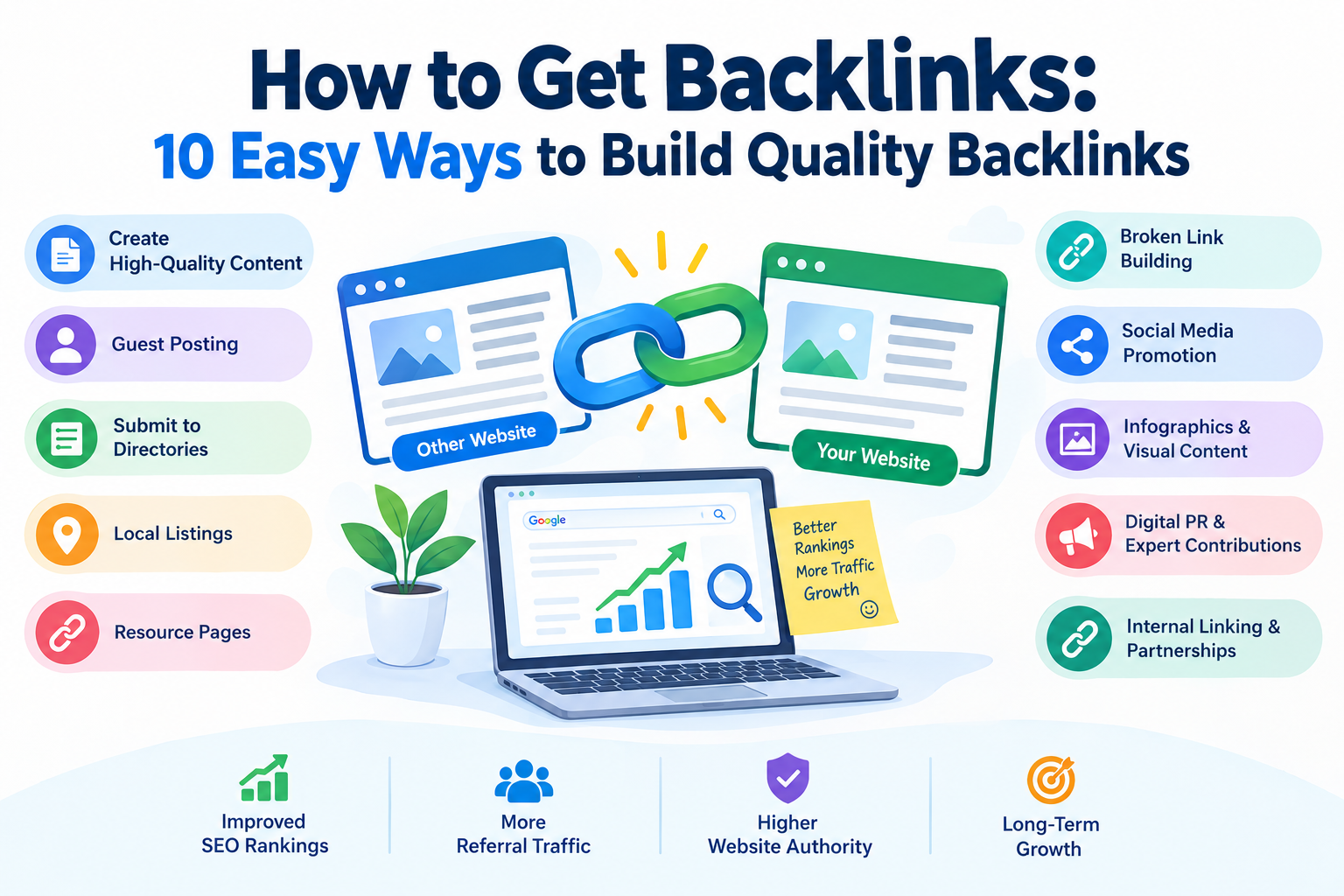
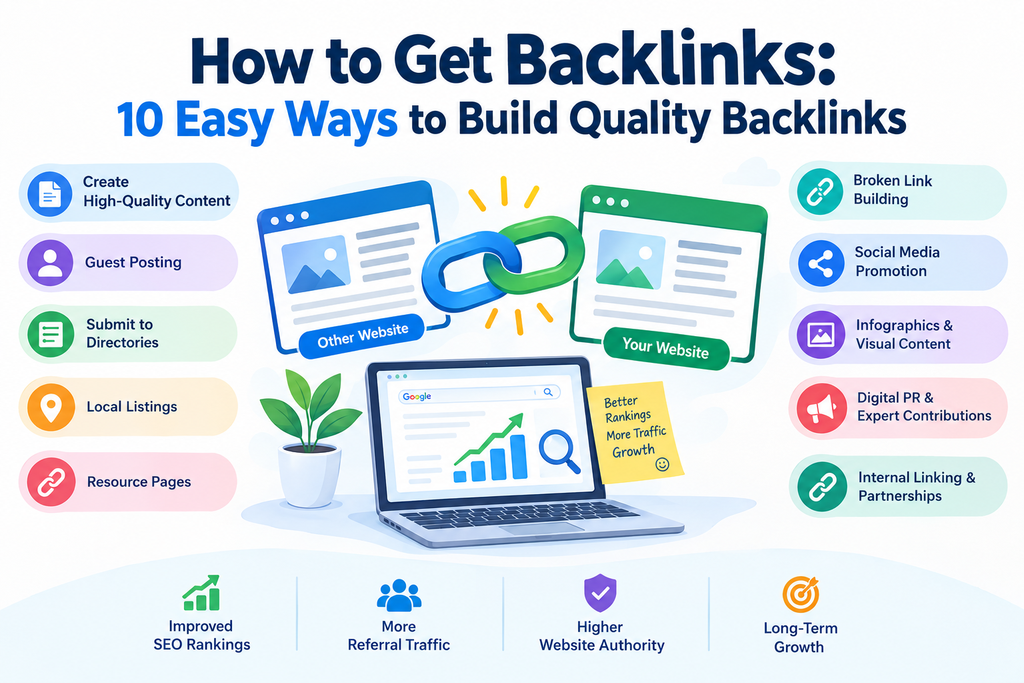
How to Get Backlinks: 10 Easy Ways
Now that you understand what backlinks are, let’s explore practical backlink building strategies for beginners.
1. Create High-Quality and Useful Content
One of the best ways to get backlinks is to publish content that other people want to reference.
When your content answers a question, provides useful information, or solves a problem, other website owners may find it worth linking to.
Examples of content that can attract backlinks include:
Beginner-friendly SEO guides
Original research and statistics
Step-by-step tutorials
Helpful checklists
Detailed how-to articles
Infographics and useful resources
For example, if you write a complete guide on “How to Do SEO for a New Website,” another blogger may link to your article when explaining SEO basics.
How to make content more link-worthy
Answer common questions clearly.
Add practical examples.
Use headings and easy-to-read paragraphs.
Include original insights where possible.
Keep information accurate and updated.
Make your content more useful than a basic explanation.
Remember, creating good content does not automatically guarantee backlinks. You still need to promote it and make relevant people aware of it.
2. Guest Posting on Relevant Websites
Guest posting is a popular link-building method where you write an article for another website.
Some websites accept contributions from writers and allow a relevant link to the author’s website. This can help you reach a new audience and potentially earn a backlink.
How guest posting works
Find websites related to your topic.
Check whether they accept guest posts.
Read their content and publishing guidelines.
Suggest a useful topic.
Write an original, high-quality article.
Add a relevant link only where it provides value.
For example, if your website is about digital marketing, you can look for websites that publish content about SEO, blogging, content marketing, or social media marketing.
Important: Avoid guest-posting networks that exist mainly to create backlinks. Guest posts should be created for real readers, not just search engine manipulation.
3. Submit Your Website to Relevant Directories
Website directories are platforms that organize websites by category or industry.
Some legitimate directories allow businesses, organizations, or websites to create listings. These listings may include a website link.
Examples include:
Relevant industry directories
Local business directories
Professional association directories
Reputable niche directories
For example, if you run a local business, a relevant local directory may help people discover your business.
Tips for directory backlinks
Choose directories related to your website.
Use accurate business information.
Avoid spammy directories.
Do not submit your website to hundreds of low-quality websites.
Prefer directories that provide genuine value to users.
Directory links are not automatically powerful backlinks. Relevance and quality matter more than the number of submissions.
4. Use Business and Local Listings
If you own a business, local listings can be a useful way to build online visibility.
You can create profiles on relevant platforms where businesses are listed. Depending on the platform, your profile may include your website URL.
For example, a local clothing shop can create business listings on relevant local platforms and industry directories.
These listings can help customers find your business and may provide backlink opportunities.
Best practices
Keep your business name consistent.
Add the correct website address.
Write a clear business description.
Include accurate contact details.
Keep your listings updated.
Local listings are especially useful for businesses targeting customers in a particular city or area.
5. Build Backlinks Through Resource Pages
Resource pages are webpages that collect useful links about a specific topic.
For example, a website about digital marketing may have a resource page listing useful SEO guides, tools, and tutorials.
If your article is genuinely useful, you can contact the website owner and suggest it as a resource.
Example
You publish an article called “Keyword Research for Beginners.”
You find a resource page about beginner SEO tutorials. If your article adds value to that page, you can send a polite email suggesting your guide.
Tips
Find relevant resource pages.
Make sure your content matches the topic.
Explain why your resource is useful.
Avoid sending the same message to unrelated websites.
This strategy works best when your content genuinely fills a gap or improves the resource page.
6. Try Broken Link Building
Broken link building is a strategy where you find a broken link on another website and suggest a relevant replacement.
A broken link is a link that no longer works or leads to a missing page.
How it works
Find a relevant website.
Look for broken links on its pages.
Check whether you have a useful replacement article.
If you do not have one, consider creating a helpful resource.
Contact the website owner and politely suggest the replacement.
For example, a marketing blog may link to an old article about SEO tools that no longer exists. If you have a relevant, useful article covering the same topic, you can suggest it.
Remember: Your content should be a genuine replacement. Do not suggest unrelated pages simply to get backlinks.
7. Promote Your Content on Social Media
Social media can help people discover your content and may lead to backlink opportunities.
When you share your blog posts on platforms such as Facebook, Instagram, LinkedIn, or Pinterest, more people may see your work.
A blogger, business owner, or content creator may discover your article and decide to link to it from their website.
How to promote your blog
Share your article on relevant social media platforms.
Create short posts summarizing useful points.
Use attractive visuals.
Join relevant online communities.
Share content where it genuinely helps people.
Social media links are not all treated the same way as editorial backlinks. Their biggest benefit is often content discovery, audience building, and referral traffic.
8. Create Infographics and Visual Content
Visual content can be a useful way to attract backlinks.
People often use images, charts, and infographics to explain complicated topics more easily.
For example, you can create an infographic about:
Types of SEO
On-page SEO checklist
Keyword research steps
Benefits of content marketing
SEO mistakes beginners should avoid
If another website finds your infographic useful, it may link to your original article or resource.
How to create link-worthy visuals
Use accurate information.
Keep the design simple.
Add a clear title.
Include your website name or source.
Make the visual easy to understand.
Share it with relevant websites and communities.
You can use Canva to create professional-looking infographics, even if you are a beginner.
9. Use Digital PR and Expert Contributions
Digital PR is another way to earn backlinks by sharing useful information with journalists, bloggers, and online publications.
For example, a journalist writing about digital marketing may need expert opinions, statistics, or helpful explanations.
If you have relevant knowledge, you can contribute valuable information.
Ways to use digital PR
Share original research.
Offer expert opinions on topics you understand.
Respond to relevant journalist requests.
Publish useful industry insights.
Build relationships with writers and publishers.
The key is to provide genuine value. Do not make up expertise or information just to obtain a backlink.
Digital PR can take time, but it may help you earn links from relevant publications.
10. Use Internal Linking and Content Partnerships
Internal links are links from one page of your website to another page on the same website. They are not backlinks because they do not come from another domain.
However, internal linking is still an important part of SEO.
For example, if you write a blog about backlinks, you can link to your other article about off-page SEO.
This helps readers discover related content and helps search engines understand your website structure.
Content partnerships
You can also collaborate with relevant bloggers, creators, or businesses to create useful content.
Examples include:
Expert roundups
Interviews
Collaborative guides
Original research
Helpful resource exchanges
These partnerships may lead to genuine backlinks when the content is valuable and published on relevant websites.
Avoid exchanging links excessively or creating partnerships solely for manipulating rankings.
What Makes a Backlink High-Quality?
Not all backlinks are equally valuable. When learning how to get backlinks, focus on quality rather than quantity.
Here are some factors that matter.
Relevance
A backlink from a website related to your topic is generally more useful than one from an unrelated website.
For example, a backlink from an SEO website to your SEO blog is more relevant than a random link from an unrelated website.
Trustworthy Website
Links from reputable websites can be valuable. However, website reputation should not be judged only by a third-party authority score.
Natural Placement
A backlink should fit naturally within the content. Links that help readers understand a topic are generally better than links placed randomly.
Useful Anchor Text
Anchor text is the clickable text of a link.
For example:
“Learn more about keyword research for beginners.”
The clickable words are the anchor text.
Use clear and natural anchor text. Avoid forcing the exact same keyword into every backlink.
Common Backlink Building Mistakes to Avoid
Beginners often make mistakes while trying to build backlinks. Avoid these practices:
Buying Spammy Backlinks
Buying links that are intended to manipulate search rankings can violate search engine spam policies.
Using Unrelated Websites
Getting links from completely unrelated websites may not provide meaningful SEO value.
Creating Too Many Low-Quality Links
Hundreds of poor-quality backlinks are not necessarily better than a few relevant, useful links.
Overusing Exact-Match Anchor Text
Using the same keyword-rich anchor text repeatedly can look unnatural.
Copying Other Websites’ Content
Duplicate or copied content is not a reliable way to earn valuable backlinks. Focus on creating original and useful resources.
How Long Does It Take to Get Backlinks?
There is no fixed time required to get backlinks. It depends on your content quality, website niche, outreach efforts, and the websites you contact.
Some backlinks may be earned within days, while others can take weeks or months.
For a new website, focus on building relationships, publishing useful content, and promoting your articles consistently.
Do not expect instant SEO results. Backlink building is a long-term process.
Final Thoughts
Learning how to get backlinks is an important part of building a successful SEO strategy. Backlinks can help with content discovery, referral traffic, and search engine visibility when they are earned naturally from relevant and trustworthy websites.
The best way to build backlinks is to create useful content, promote your articles, contribute to relevant websites, and focus on genuine relationships.
Start with simple strategies such as creating high-quality blog posts, submitting to relevant directories, promoting your content on social media, and trying guest posting.
Remember, quality backlinks are more important than the number of backlinks. Stay consistent, follow ethical SEO practices, and focus on providing value to readers.
Over time, your website can build a stronger online presence and attract more visitors through effective link-building strategies.
Learn on-page SEO with this beginner-friendly guide. Discover title tags, meta descriptions, keyword placement, internal linking, and more.
If you have recently started a website or blog, you may have heard about SEO and wondered how to make your pages appear higher in Google search results. One of the most important parts of SEO is on-page SEO. It helps search engines understand your content and helps readers find useful information on your website.
Whether you are a complete beginner, a blogger, or a website owner, learning on-page SEO can help you create better content and improve your website’s visibility.
In this beginner’s guide, you will learn what on-page SEO is, why it is important, and how to optimize your website using simple techniques.
What Is On-Page SEO?
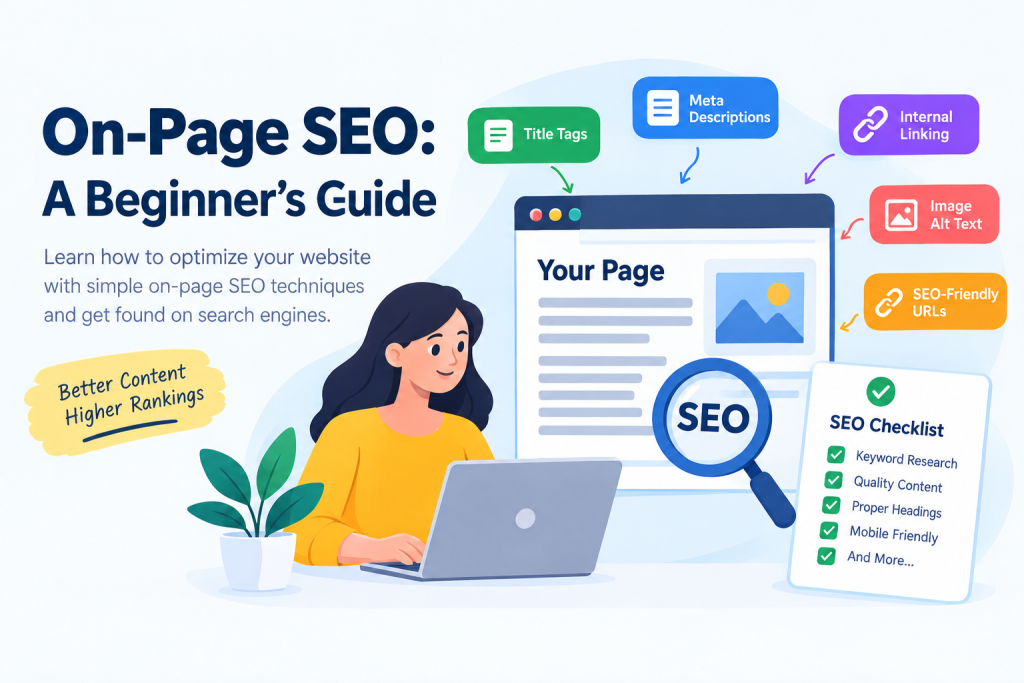
On-page SEO is the process of optimizing individual webpages to improve their visibility in search engines and provide a better experience for visitors. It includes the content on your page as well as certain HTML elements, such as title tags, headings, and image alt text.
The main purpose of on-page SEO is to help search engines understand what your webpage is about and whether it provides useful information for people searching for that topic.
For example, if you write a blog about “How to Do Keyword Research for Beginners,” you can use on-page SEO to improve the page by:
Using a relevant focus keyword.
Creating a clear and useful SEO title.
Writing a helpful meta description.
Organizing the content with headings.
Adding relevant internal links.
Optimizing images with descriptive alt text.
These techniques help make your content easier to understand and navigate.
Why Is On-Page SEO Important?
On-page SEO is important because it helps search engines understand your content and helps users find the information they need. A well-optimized webpage can also provide a better reading experience.
Here are some important benefits of on-page SEO.
1. Helps Search Engines Understand Your Content
Search engines use different signals to understand the topic and relevance of a webpage. Clear titles, headings, and useful content help communicate what your page is about.
For example, a page titled “On-Page SEO: A Beginner’s Guide” clearly tells readers and search engines that the article focuses on on-page SEO for beginners.
2. Improves User Experience
Good on-page SEO is not only about search engines. It also makes your website easier for visitors to use.
When your content has clear headings, short paragraphs, descriptive links, and helpful information, readers can find answers more easily.
A better user experience can encourage visitors to explore more pages on your website.
3. Helps Your Website Reach Relevant Visitors
When your content matches what people are searching for, it has a better chance of appearing in relevant search results.
For example, someone searching for “on-page SEO techniques” may be interested in a guide explaining keyword placement, title tags, internal linking, and image optimization.
Creating content that matches the searcher’s needs is an important part of SEO.
4. Supports Long-Term Website Growth
SEO is not an instant process. A new website may take time to gain visibility and attract organic traffic.
By consistently publishing useful content and applying on-page SEO best practices, you can build a stronger foundation for long-term growth.
SEO is commonly divided into different areas, including on-page SEO, off-page SEO, and technical SEO.
Understanding the difference can help you choose the right optimization techniques.
Type of SEO
Meaning
On-page SEO
Optimizing content and webpage elements.
Off-page SEO
Building reputation and authority through activities outside your website.
Technical SEO
Improving technical aspects that help search engines crawl, understand, and access your website.
Important On-Page SEO Techniques
Now that you understand what on-page SEO is, let’s look at the most important techniques you can use on your website.
1. Perform Keyword Research
Keyword research is one of the first steps in creating an SEO-friendly blog. It helps you understand what people search for and what topics you should cover.
A keyword is a word or phrase that people enter into search engines to find information.
For example:
On-page SEO.
On-page SEO for beginners.
How to do on-page SEO.
On-page SEO checklist.
When choosing a keyword, consider its relevance, search intent, search volume, and competition.
If you are a beginner with a new website, you may want to explore specific, lower-competition keywords that match your content.
For example, instead of targeting only “SEO,” you could create a detailed article about “on-page SEO for beginners.”
Use your focus keyword naturally in your content. Avoid repeating it unnecessarily because keyword stuffing can make your content difficult to read.
2. Create an SEO-Friendly Title Tag
The title tag is an important HTML element that helps describe the topic of a webpage. Search engines may use it as the title of your search result.
A good title should be clear, descriptive, and relevant to the page.
For example:
Poor title:
SEO Tips
Better title:
On-Page SEO: A Beginner’s Guide to Optimizing Your Website
The better title explains the topic and tells readers what they can expect.
Best practices for title tags include:
Include your focus keyword naturally.
Keep the title relevant to the actual content.
Make it clear and easy to understand.
Avoid unnecessary repetition.
Write a title that encourages the right audience to click.
Your title tag and blog heading can be similar, but they do not have to be exactly the same.
3. Write a Useful Meta Description
A meta description is a short summary of a webpage. It can appear below the title in search results, although Google may choose a different snippet from your page.
A good meta description helps users understand what your article offers.
For example:
“Learn on-page SEO with this beginner-friendly guide. Discover title tags, meta descriptions, keyword placement, internal linking, and SEO best practices.”
This description includes the focus keyword and explains the main topics covered in the article.
Tips for writing a meta description:
Include your focus keyword naturally.
Summarize the main benefit of the article.
Make it clear and relevant.
Avoid keyword stuffing.
Use a concise length, commonly around 150–160 characters as a practical guideline.
Remember that a meta description does not guarantee higher rankings, but it can help communicate the value of your page to searchers.
4. Use Proper Heading Tags
Headings help organize your content and make it easier to read.
The main heading is usually an H1, while subheadings use H2 and H3 tags.
For example:
H1: On-Page SEO: A Beginner’s Guide
H2: What Is On-Page SEO?
H2: Why Is On-Page SEO Important?
H2: Important On-Page SEO Techniques
H3: Perform Keyword Research
H3: Create an SEO-Friendly Title Tag
A clear heading structure helps readers understand the organization of your article.
Use headings to divide your content into meaningful sections. Do not add keywords to headings just to repeat them. Every heading should describe the information that follows.
5. Optimize Keyword Placement
Keyword placement means using your focus keyword in relevant areas of your webpage.
For example, if your focus keyword is “on-page SEO,” you may include it in:
SEO title.
Main heading.
Introduction.
Relevant subheadings.
Body content.
Meta description.
URL, when appropriate.
However, you do not need to place the keyword in every paragraph.
Search engines can understand related words and the overall topic of your content. Focus on writing naturally and explaining the subject thoroughly.
6. Add Internal Links
Internal linking is the process of linking one page of your website to another page on the same website.
It helps readers discover related content and allows search engines to find and understand the relationship between pages.
For example, if you are writing an article about on-page SEO, you could link to another blog about:
What Is SEO?
Keyword Research for Beginners.
How Long Does It Take to Increase Website Traffic?
SEO-Friendly Blog Writing.
Use descriptive anchor text for your links.
For example:
“Learn more about [keyword research for beginners] to find relevant topics for your website.”
Descriptive anchor text tells readers what they can expect after clicking.
Internal links can also help visitors spend more time exploring useful content on your website.
7. Optimize Images With Alt Text
Images can make your blog more attractive and easier to understand. However, search engines may not fully understand an image just by looking at it.
Alt text is a short description of an image that helps explain its content. It can also improve accessibility for people using screen readers.
Good alt text should:
Describe the image accurately.
Be concise and useful.
Include a keyword only when it naturally describes the image.
Avoid keyword stuffing.
Not begin with unnecessary phrases such as “Image of” in every case.
If an image is purely decorative, it may not need descriptive alt text.
8. Create SEO-Friendly URLs
A URL is the web address of a page. A clear URL helps users understand what the page is about.
An SEO-friendly URL should be short, descriptive, and relevant to the content.
Tips for creating URLs:
Use words that describe the topic.
Include the main keyword when appropriate.
Use hyphens to separate words.
Avoid unnecessary numbers and symbols.
Keep the URL simple.
For your article, a suitable URL could be:
yourwebsite.com/on-page-seo-guide
A good URL is helpful, but changing URLs unnecessarily can create problems. If you change an existing page URL, use appropriate redirects when needed.
9. Write High-Quality and Helpful Content
One of the most important parts of on-page SEO is creating useful content.
Search engines aim to show people relevant and helpful information. Therefore, your article should focus on answering the reader’s questions rather than simply inserting keywords.
Helpful content should:
Answer the main search query.
Be easy for beginners to understand.
Provide accurate and relevant information.
Use examples where helpful.
Avoid unnecessary repetition.
Be organized with clear headings.
Instead of writing a short article that only defines on-page SEO, create a guide that explains how readers can actually apply it to their own websites.
10. Improve Readability and Page Experience
Readability refers to how easy your content is to read and understand.
Even if your article contains useful information, readers may leave if the page is difficult to navigate.
You can improve readability by:
Writing short paragraphs.
Using bullet points.
Adding clear headings.
Avoiding overly complicated sentences.
Using simple language.
Leaving enough spacing between sections.
You should also make sure your website works well on mobile devices.
A page that loads slowly, has difficult navigation, or displays poorly on mobile can create a frustrating experience.
Page experience is broader than on-page SEO alone, but it is an important part of creating a website that users enjoy.
Keyword Stuffing
Keyword stuffing means using the same keyword excessively in an attempt to manipulate search rankings.
Writing Only for Search Engines
Some people focus so much on keywords that they forget the reader.
Your content should answer real questions and provide value. Search engines are important, but your main goal should be helping your audience.
Ignoring Internal Links
If you publish several useful articles but never link them together, readers may have difficulty discovering your other content.
Using the Same Meta Description Everywhere
Every important webpage should have a relevant meta description when appropriate.
Publishing Without Checking the Page
Before publishing, check your title, URL, images, headings, and formatting.
Final Thoughts
On-page SEO is an essential part of building a search-friendly website. It helps search engines understand your content and makes your webpages easier for visitors to use.
By applying simple techniques such as keyword research, title optimization, meta descriptions, heading structure, internal linking, image alt text, and helpful content, beginners can create a stronger SEO foundation.
Remember that SEO is not just about using keywords. It is about providing useful information that matches what people are searching for.
Start with one webpage, apply these on-page SEO techniques, and continue improving your content over time.
The more consistently you practice SEO, the better you can understand what works for your website and your audience.
Learn how to get more traffic to your website with SEO, keyword research, content marketing, and proven strategies to attract visitors and grow your online presence.
Getting traffic to a website is one of the biggest challenges for beginners starting their online journey. You may have a well-designed website and useful content, but without visitors, it can be difficult to grow your online presence. Whether you have a new blog, a business website, or a personal website, attracting the right audience is essential for success.
The good news is that you don’t always need to spend money on advertisements to get more visitors. With the right SEO strategies, keyword research, high-quality content, and social media marketing, you can gradually increase your website traffic and reach more people.
In this guide, we will explore how to get more traffic to your website, the best ways to attract visitors, and practical strategies beginners can use to grow their website organically.
Website traffic refers to the number of visitors who visit a website and the activities they perform while browsing its pages. Every time someone visits your blog, reads an article, explores your products, or checks your services, it contributes to your website traffic. For beginners, understanding website traffic is an important step toward learning how to get more traffic to your website and grow an online presence.
Whether you own a personal blog, a business website, an online store, or a portfolio, visitors are essential for reaching your goals. A website can have an attractive design and useful content, but without people visiting it, your content may not reach the audience you want. This is why increasing website traffic is one of the main goals of many website owners and digital marketers.
In this section, we will understand what website traffic means, why website visitors are important, and the difference between organic traffic and paid traffic.
What Does Website Traffic Mean?
Website traffic means the visits and visitors a website receives over a particular period. It helps website owners understand how many people are discovering their website and how they interact with its content.
For example, imagine you have a blog about digital marketing for beginners. You publish an article titled “How to Get More Traffic to Your Website.” If 100 people visit your blog and read the article, your website has received traffic from those visits.
However, website traffic is not only about the number of people visiting your website. It also includes information such as where visitors come from, which pages they visit, and how long they stay.
Important Website Traffic Metrics
Understanding basic traffic metrics can help you measure your website’s performance.
1. Users
Users represent the people who visit your website. Depending on the analytics platform and reporting method, this can refer to unique or active users.
2. Sessions
A session is a group of interactions a visitor has with your website during a period of activity. One person can have multiple sessions.
3. Pageviews
Pageviews measure the number of times pages on your website are viewed. If someone visits three different pages, those views contribute to your pageview count.
4. Traffic Sources
Traffic sources tell you where your visitors come from. They may discover your website through Google, social media, another website, or a paid advertisement.
By monitoring these metrics, you can understand how visitors interact with your website and identify opportunities to improve your content.
Why Is Website Traffic Important?
Website traffic is important because it helps your content, products, or services reach more people. More visitors can create opportunities for engagement, leads, sales, and long-term growth. However, getting more traffic does not automatically guarantee success. The quality and relevance of your visitors also matter.
Here are some important reasons why website traffic is valuable.
1. Helps More People Discover Your Website
The first benefit of increasing website traffic is that more people can discover your online presence. If you have recently started a blog or launched a new website, attracting visitors can help you reach your target audience.
For example, if you write articles about SEO, visitors searching for digital marketing information may discover your blog through search engines. When your content answers their questions, they may return to read more articles.
This is why learning how to get more visitors to your website is important for beginners.
2. Increases Brand Awareness
Website traffic can help people become familiar with your brand, blog, or business. When visitors repeatedly see your content, they may begin to recognize your website and remember what you offer.
For example, a website that regularly publishes helpful articles about fashion, beauty, or digital marketing can gradually build recognition among its audience.
Consistent content and a clear website identity can help create a stronger online presence.
3. Creates Opportunities to Earn Money
For many website owners, increasing website traffic is an important part of earning money online.
A website can generate income through different methods, such as:
Selling products or services.
Affiliate marketing.
Display advertising.
Sponsored content.
Selling digital products or courses.
For example, a blog about digital marketing may recommend useful tools through affiliate links. If visitors make qualifying purchases through those links, the website owner may earn a commission, depending on the affiliate program.
However, traffic alone does not guarantee income. Visitors must be interested in what the website offers, and the monetization method must be suitable for the audience.
4. Helps You Understand Your Audience
Website traffic data can help you understand what your visitors are interested in.
For example, suppose you publish five blog posts:
What Is SEO?
How to Get More Traffic to Your Website
What Is Keyword Research?
How to Use Canva
What Is Social Media Marketing?
If one article receives significantly more visitors than the others, it may indicate that the topic is attracting more interest. You can use this information to plan related content.
Analytics tools can also show which pages receive traffic, where visitors come from, and how they interact with your website.
5. Supports Business Growth
For a business website, visitors can become potential customers. When people search for a product or service and find your website, they may contact your business, request information, or make a purchase.
For example, a local cafe can attract visitors by publishing useful content about its menu, location, and services. People searching for cafes in that area may discover the website through Google.
This is one reason why businesses focus on website traffic generation strategies.
What Is Organic Traffic?
Organic traffic refers to visitors who reach your website through unpaid search engine results.
For example, someone searches Google for “how to increase website traffic.” They click on your blog post from the unpaid search results and visit your website. That visit is considered organic search traffic.
Organic traffic is closely connected to Search Engine Optimization (SEO). SEO helps search engines understand your content and can improve your chances of appearing in relevant search results.
How to Increase Organic Traffic
Some common ways to increase organic traffic include:
Performing keyword research.
Creating helpful, high-quality content.
Optimizing title tags and meta descriptions.
Using relevant headings.
Improving website speed and mobile usability.
Adding internal links.
Earning relevant backlinks.
Organic traffic can be valuable because it may continue bringing visitors after content is published. However, SEO takes time, and search rankings are not guaranteed.
What Is Paid Traffic?
Paid traffic refers to visitors who reach your website through advertisements or other paid promotional campaigns.
For example, a business may run a Google Ads campaign for the keyword “digital marketing course.” When someone clicks the advertisement and visits the website, that visit is paid traffic.
Paid traffic can help businesses reach an audience quickly, depending on the campaign, budget, targeting, and competition.
Common Sources of Paid Traffic
Google Ads.
Facebook and Instagram Ads.
YouTube Ads.
Display advertising.
Sponsored online promotions.
Paid traffic can be useful when launching a product, promoting a service, or attracting visitors to a new offer.
Organic Traffic vs Paid Traffic
The main difference between organic and paid traffic is how visitors reach your website.
Feature
Organic Traffic
Paid Traffic
Cost
No direct payment for each organic click
Usually requires an advertising budget
Main source
Unpaid search results
Advertisements
Main strategy
SEO and content marketing
Paid advertising
Speed
Can take time to build
Can start generating visits when campaigns run
Long-term value
Can continue after publishing content
Usually depends on ongoing campaigns
Both methods can be useful. Many website owners combine SEO and paid advertising to attract visitors and grow their online presence.
How Long Does It Take to Increase Website Traffic?
There is no fixed amount of time required to increase website traffic. The results can vary depending on your website’s age, competition, content quality, SEO strategy, keyword difficulty, and how consistently you publish and promote your content. A new website may take several months to build noticeable organic traffic, while an established website with strong SEO authority may see improvements more quickly.
If you are starting a new website, it is important to be patient and focus on creating a strong foundation. Search engines need time to discover, crawl, index, and evaluate your content. Publishing one or two articles does not usually lead to a large increase in visitors immediately. Instead, consistently publishing useful and well-optimized content can help your website gradually gain visibility.
How SEO Affects Website Traffic Growth
SEO is one of the most effective ways to increase organic traffic, but it is a long-term strategy. Your pages may initially appear low in search results, especially when you are targeting competitive keywords. As your website gains useful content, backlinks, and authority, some pages may gradually move higher in search results and attract more visitors.
For beginners, targeting relevant keywords with lower competition can sometimes help a new website gain visibility more easily. You should also optimize your titles, headings, meta descriptions, internal links, and content while making sure that your articles provide genuine value to readers.
How to Increase Website Traffic Faster
Although there is no guaranteed shortcut, you can give your website more opportunities to attract visitors by using several strategies together. Publish high-quality content regularly, promote your articles on social media, improve your SEO, build relevant backlinks, and update older content when necessary.
You can also use paid advertising if you want to generate website visits while your organic traffic is still developing. However, paid traffic usually stops when you stop running the advertisements, whereas successful SEO can continue bringing organic visitors over time.
Instead of focusing only on how quickly you can get more traffic to your website, focus on building sustainable traffic. Track your visitors using analytics tools, identify which pages perform well, and create more content around topics that your audience is searching for.
For a new website, consistent effort is more important than expecting immediate results. As your content library grows and your SEO improves, your website can gradually attract more visitors and build a stronger online presence.
Conclusion
Website traffic is an important part of building a successful online presence. It helps people discover your content, increases brand awareness, creates opportunities to earn money, and supports business growth.
If you are a beginner wondering how to get more traffic to your website, understanding organic and paid traffic is a great starting point. Organic traffic focuses on SEO and helpful content, while paid traffic uses advertisements to attract visitors.
In the next section, we will explore practical ways to increase website traffic, improve your online visibility, and attract the right audience to your website.