Learn how to get backlinks with 10 easy and effective strategies. Discover how to build quality backlinks, improve SEO, and increase website traffic.
If you want to increase your website traffic and improve your search engine rankings, learning how to get backlinks is an important part of SEO. Backlinks are links from other websites that point to your website. They help search engines understand that your content may be useful and trustworthy.
For beginners, building backlinks can seem difficult. You may wonder where to find backlink opportunities, how to contact website owners, or whether you need to spend money to get links. The good news is that there are several simple ways to build backlinks, even if you have a new website.
In this guide, you will learn how to get backlinks using 10 effective strategies. We will also explain what makes a backlink valuable, how to build links naturally, and common mistakes to avoid.
What Are Backlinks?
Backlinks are links from one website to another website. For example, imagine you write a blog about SEO for beginners. Another website finds your article useful and adds a link to it in one of its blog posts. That link is called a backlink.
Backlinks are also known as inbound links or incoming links.
Search engines use links as one part of understanding websites and their content. A relevant, editorially placed link from a trustworthy website can be a useful signal of credibility.
However, not every backlink has the same value. A link from a relevant, trusted website may be more useful than a link from an unrelated or low-quality website.
Example of a backlink
Suppose you have a website called MySEOGuide and publish an article titled “Keyword Research for Beginners.”
A digital marketing website writes an article about SEO tools and links to your keyword research guide.
That link is a backlink to your website.
Why Are Backlinks Important for SEO?
Backlinks are an important part of off-page SEO. They can help search engines discover pages, understand relationships between websites, and evaluate signals of authority.
Here are some important benefits of backlinks.
1. Improve Website Authority
When relevant and trustworthy websites link to your content, it can support your website’s credibility. This does not guarantee higher rankings, but quality backlinks can contribute to a stronger SEO profile.
2. Increase Referral Traffic
Backlinks can bring visitors directly from another website. If someone clicks a link in a blog post and visits your website, that is called referral traffic.
For example, if a popular marketing blog links to your SEO guide, interested readers may visit your website to learn more.
3. Help Search Engines Discover Content
Search engines can use links to discover new pages. A backlink from a page that search engines can access may help them find your content.
However, a backlink does not guarantee that a page will be crawled, indexed, or ranked.
4. Support Long-Term SEO Growth
Building useful backlinks is a long-term SEO strategy. When you consistently publish valuable content and earn relevant links, you can create a stronger foundation for your website.
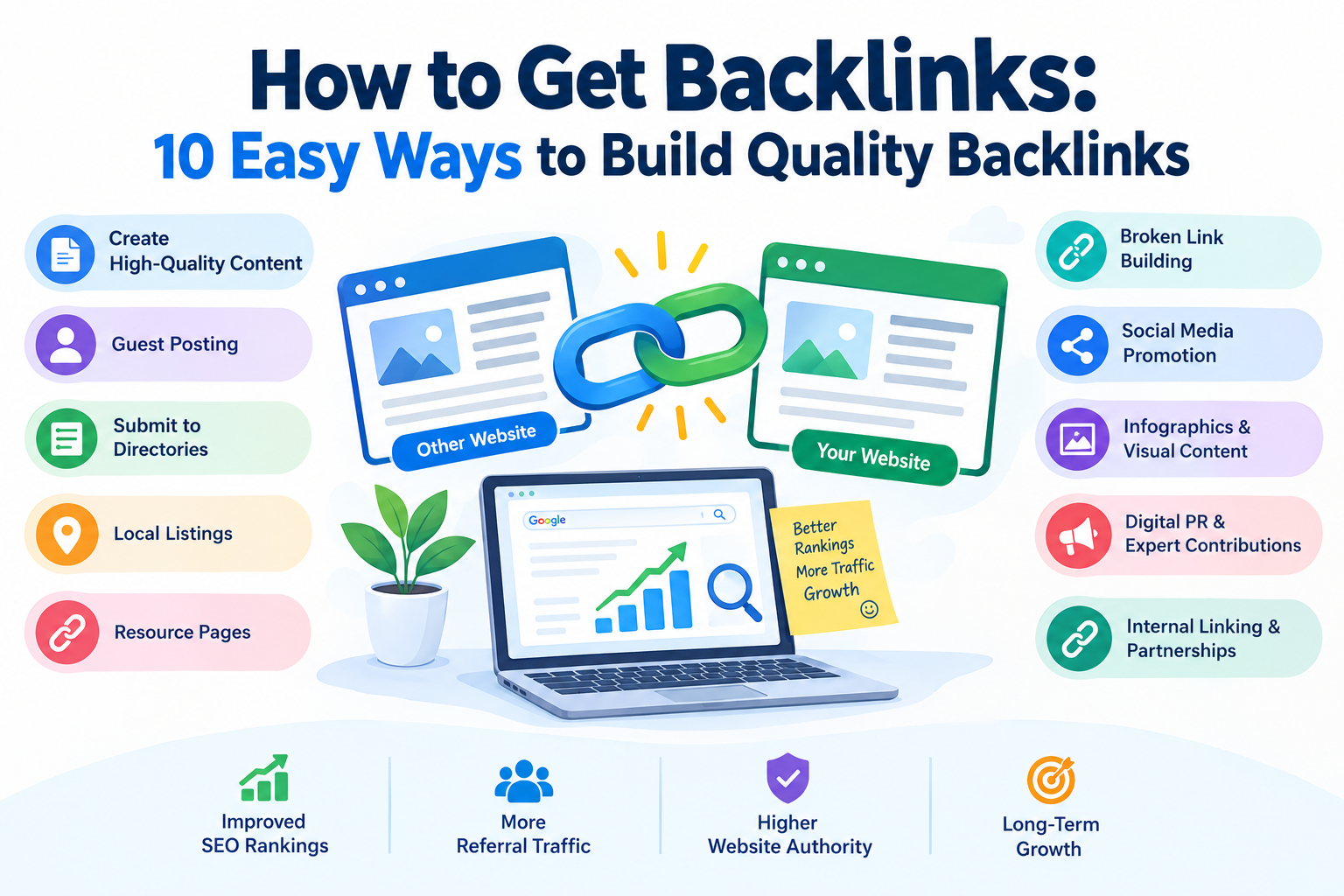
How to Get Backlinks: 10 Easy Ways
Now that you understand what backlinks are, let’s explore practical backlink building strategies for beginners.
1. Create High-Quality and Useful Content
One of the best ways to get backlinks is to publish content that other people want to reference.
When your content answers a question, provides useful information, or solves a problem, other website owners may find it worth linking to.
Examples of content that can attract backlinks include:
- Beginner-friendly SEO guides
- Original research and statistics
- Step-by-step tutorials
- Helpful checklists
- Detailed how-to articles
- Infographics and useful resources
For example, if you write a complete guide on “How to Do SEO for a New Website,” another blogger may link to your article when explaining SEO basics.
How to make content more link-worthy
- Answer common questions clearly.
- Add practical examples.
- Use headings and easy-to-read paragraphs.
- Include original insights where possible.
- Keep information accurate and updated.
- Make your content more useful than a basic explanation.
Remember, creating good content does not automatically guarantee backlinks. You still need to promote it and make relevant people aware of it.
2. Guest Posting on Relevant Websites
Guest posting is a popular link-building method where you write an article for another website.
Some websites accept contributions from writers and allow a relevant link to the author’s website. This can help you reach a new audience and potentially earn a backlink.
How guest posting works
- Find websites related to your topic.
- Check whether they accept guest posts.
- Read their content and publishing guidelines.
- Suggest a useful topic.
- Write an original, high-quality article.
- Add a relevant link only where it provides value.
For example, if your website is about digital marketing, you can look for websites that publish content about SEO, blogging, content marketing, or social media marketing.
Important: Avoid guest-posting networks that exist mainly to create backlinks. Guest posts should be created for real readers, not just search engine manipulation.
3. Submit Your Website to Relevant Directories
Website directories are platforms that organize websites by category or industry.
Some legitimate directories allow businesses, organizations, or websites to create listings. These listings may include a website link.
Examples include:
- Relevant industry directories
- Local business directories
- Professional association directories
- Reputable niche directories
For example, if you run a local business, a relevant local directory may help people discover your business.
Tips for directory backlinks
- Choose directories related to your website.
- Use accurate business information.
- Avoid spammy directories.
- Do not submit your website to hundreds of low-quality websites.
- Prefer directories that provide genuine value to users.
Directory links are not automatically powerful backlinks. Relevance and quality matter more than the number of submissions.
4. Use Business and Local Listings
If you own a business, local listings can be a useful way to build online visibility.
You can create profiles on relevant platforms where businesses are listed. Depending on the platform, your profile may include your website URL.
For example, a local clothing shop can create business listings on relevant local platforms and industry directories.
These listings can help customers find your business and may provide backlink opportunities.
Best practices
- Keep your business name consistent.
- Add the correct website address.
- Write a clear business description.
- Include accurate contact details.
- Keep your listings updated.
Local listings are especially useful for businesses targeting customers in a particular city or area.
5. Build Backlinks Through Resource Pages
Resource pages are webpages that collect useful links about a specific topic.
For example, a website about digital marketing may have a resource page listing useful SEO guides, tools, and tutorials.
If your article is genuinely useful, you can contact the website owner and suggest it as a resource.
Example
You publish an article called “Keyword Research for Beginners.”
You find a resource page about beginner SEO tutorials. If your article adds value to that page, you can send a polite email suggesting your guide.
Tips
- Find relevant resource pages.
- Make sure your content matches the topic.
- Explain why your resource is useful.
- Avoid sending the same message to unrelated websites.
This strategy works best when your content genuinely fills a gap or improves the resource page.
6. Try Broken Link Building
Broken link building is a strategy where you find a broken link on another website and suggest a relevant replacement.
A broken link is a link that no longer works or leads to a missing page.
How it works
- Find a relevant website.
- Look for broken links on its pages.
- Check whether you have a useful replacement article.
- If you do not have one, consider creating a helpful resource.
- Contact the website owner and politely suggest the replacement.
For example, a marketing blog may link to an old article about SEO tools that no longer exists. If you have a relevant, useful article covering the same topic, you can suggest it.
Remember: Your content should be a genuine replacement. Do not suggest unrelated pages simply to get backlinks.
7. Promote Your Content on Social Media
Social media can help people discover your content and may lead to backlink opportunities.
When you share your blog posts on platforms such as Facebook, Instagram, LinkedIn, or Pinterest, more people may see your work.
A blogger, business owner, or content creator may discover your article and decide to link to it from their website.
How to promote your blog
- Share your article on relevant social media platforms.
- Create short posts summarizing useful points.
- Use attractive visuals.
- Join relevant online communities.
- Share content where it genuinely helps people.
Social media links are not all treated the same way as editorial backlinks. Their biggest benefit is often content discovery, audience building, and referral traffic.
8. Create Infographics and Visual Content
Visual content can be a useful way to attract backlinks.
People often use images, charts, and infographics to explain complicated topics more easily.
For example, you can create an infographic about:
- Types of SEO
- On-page SEO checklist
- Keyword research steps
- Benefits of content marketing
- SEO mistakes beginners should avoid
If another website finds your infographic useful, it may link to your original article or resource.
How to create link-worthy visuals
- Use accurate information.
- Keep the design simple.
- Add a clear title.
- Include your website name or source.
- Make the visual easy to understand.
- Share it with relevant websites and communities.
You can use Canva to create professional-looking infographics, even if you are a beginner.
9. Use Digital PR and Expert Contributions
Digital PR is another way to earn backlinks by sharing useful information with journalists, bloggers, and online publications.
For example, a journalist writing about digital marketing may need expert opinions, statistics, or helpful explanations.
If you have relevant knowledge, you can contribute valuable information.
Ways to use digital PR
- Share original research.
- Offer expert opinions on topics you understand.
- Respond to relevant journalist requests.
- Publish useful industry insights.
- Build relationships with writers and publishers.
The key is to provide genuine value. Do not make up expertise or information just to obtain a backlink.
Digital PR can take time, but it may help you earn links from relevant publications.
10. Use Internal Linking and Content Partnerships
Internal links are links from one page of your website to another page on the same website. They are not backlinks because they do not come from another domain.
However, internal linking is still an important part of SEO.
For example, if you write a blog about backlinks, you can link to your other article about off-page SEO.
This helps readers discover related content and helps search engines understand your website structure.
Content partnerships
You can also collaborate with relevant bloggers, creators, or businesses to create useful content.
Examples include:
- Expert roundups
- Interviews
- Collaborative guides
- Original research
- Helpful resource exchanges
These partnerships may lead to genuine backlinks when the content is valuable and published on relevant websites.
Avoid exchanging links excessively or creating partnerships solely for manipulating rankings.
What Makes a Backlink High-Quality?
Not all backlinks are equally valuable. When learning how to get backlinks, focus on quality rather than quantity.
Here are some factors that matter.
Relevance
A backlink from a website related to your topic is generally more useful than one from an unrelated website.
For example, a backlink from an SEO website to your SEO blog is more relevant than a random link from an unrelated website.
Trustworthy Website
Links from reputable websites can be valuable. However, website reputation should not be judged only by a third-party authority score.
Natural Placement
A backlink should fit naturally within the content. Links that help readers understand a topic are generally better than links placed randomly.
Useful Anchor Text
Anchor text is the clickable text of a link.
For example:
“Learn more about keyword research for beginners.”
The clickable words are the anchor text.
Use clear and natural anchor text. Avoid forcing the exact same keyword into every backlink.
Common Backlink Building Mistakes to Avoid
Beginners often make mistakes while trying to build backlinks. Avoid these practices:
Buying Spammy Backlinks
Buying links that are intended to manipulate search rankings can violate search engine spam policies.
Using Unrelated Websites
Getting links from completely unrelated websites may not provide meaningful SEO value.
Creating Too Many Low-Quality Links
Hundreds of poor-quality backlinks are not necessarily better than a few relevant, useful links.
Overusing Exact-Match Anchor Text
Using the same keyword-rich anchor text repeatedly can look unnatural.
Copying Other Websites’ Content
Duplicate or copied content is not a reliable way to earn valuable backlinks. Focus on creating original and useful resources.
How Long Does It Take to Get Backlinks?
There is no fixed time required to get backlinks. It depends on your content quality, website niche, outreach efforts, and the websites you contact.
Some backlinks may be earned within days, while others can take weeks or months.
For a new website, focus on building relationships, publishing useful content, and promoting your articles consistently.
Do not expect instant SEO results. Backlink building is a long-term process.
Final Thoughts
Learning how to get backlinks is an important part of building a successful SEO strategy. Backlinks can help with content discovery, referral traffic, and search engine visibility when they are earned naturally from relevant and trustworthy websites.
The best way to build backlinks is to create useful content, promote your articles, contribute to relevant websites, and focus on genuine relationships.
Start with simple strategies such as creating high-quality blog posts, submitting to relevant directories, promoting your content on social media, and trying guest posting.
Remember, quality backlinks are more important than the number of backlinks. Stay consistent, follow ethical SEO practices, and focus on providing value to readers.
Over time, your website can build a stronger online presence and attract more visitors through effective link-building strategies.