Tag: onpageseo

  • Free SEO Tools: 15 Best Tools for Website Optimization

    Discover the best Free SEO Tools for keyword research, SEO audits, backlinks, technical SEO, and website optimization. Perfect for beginners and marketers.

    Free SEO Tools: Best Tools to Improve Your Website SEO

    Introduction

    • SEO does not always require expensive software or subscriptions.
    • Many powerful Free SEO Tools can help with keyword research, technical SEO, backlinks, website performance, and content optimization.
    • Bloggers, beginners, freelancers, business owners, and digital marketers can use these tools to improve their website’s search visibility.
    • In this guide, you will discover useful SEO tools for different SEO requirements.
    • You will also learn how to choose the right tool according to your SEO goals.

    What Are Free SEO Tools?

    • Free SEO Tools are online platforms, applications, or software that provide SEO-related features without requiring a paid subscription.
    • They can help you discover relevant keywords.
    • You can identify technical SEO problems on your website.
    • You can analyze backlinks and referring domains.
    • You can check website speed and performance.
    • You can research competitors and content opportunities.
    • Free SEO Tools for Beginners can be especially useful for people who are learning SEO and want to practice without an initial investment.

    Why Should You Use Free SEO Tools?

    1. Keyword Research

    • Discover what people are searching for.
    • Find relevant keywords for your content.
    • Identify long-tail keyword opportunities.
    • Understand different search intents.
    • Find potential topics for blog posts.
    • Free Keyword Research Tools can help beginners start their keyword research process.

    2. Website SEO Audits

    • Find broken links.
    • Identify missing or poorly optimized meta tags.
    • Discover technical SEO problems.
    • Check important website elements.
    • Analyze basic website health.
    • Free SEO Audit Tools can help you identify issues that may affect your website’s SEO performance.

    3. Website Performance

    • Check website loading speed.
    • Analyze mobile performance.
    • Review Core Web Vitals.
    • Identify performance issues.
    • Find opportunities to improve page experience.
    • Free Website SEO Tools can help you monitor different aspects of website optimization.

    15 Best Free SEO Tools

    1. Google Search Console

    • Google Search Console is an official Google platform for monitoring website performance in Google Search.
    • View search queries.
    • Monitor clicks and impressions.
    • Identify indexing issues.
    • Submit and monitor sitemaps.
    • Check pages indexed by Google.
    • Monitor search performance.

    2. Google Keyword Planner

    • Discover keyword ideas.
    • Research keyword demand.
    • Find related search terms.
    • Explore potential keywords for content.
    • Plan keywords for SEO and advertising campaigns.

    3. Google Trends

    • Analyze search trends over time.
    • Compare multiple search terms.
    • Discover trending topics.
    • Identify seasonal trends.
    • Compare interest across different locations.
    • Find topics that are gaining search interest.

    4. Google Analytics

    • Monitor website traffic.
    • Understand where visitors come from.
    • Analyze user behavior.
    • Track organic traffic.
    • Measure website engagement.
    • Understand how visitors interact with your website.

    5. Google PageSpeed Insights

    • Test website performance.
    • Analyze mobile and desktop performance.
    • Check Core Web Vitals.
    • Identify page speed problems.
    • Get recommendations for improving website performance.

    6. Bing Webmaster Tools

    • Monitor Bing search performance.
    • Check website indexing.
    • Analyze search queries.
    • Identify SEO issues.
    • Submit and manage website sitemaps.
    • Understand how your website performs in Bing Search.

    7. Ahrefs Webmaster Tools

    • Analyze your website’s SEO health.
    • Check backlinks.
    • Identify technical SEO problems.
    • Crawl your website.
    • Find SEO issues that may require attention.

    8. Semrush Free Tools

    • Perform basic keyword research.
    • Research competitors.
    • Analyze websites.
    • Explore SEO opportunities.
    • Access various SEO-related reports and tools.

    9. Ubersuggest

    • Discover keyword ideas.
    • Find content ideas.
    • Research competitors.
    • Analyze basic SEO metrics.
    • Explore related keywords.

    10. Screaming Frog SEO Spider

    • Crawl websites.
    • Find broken links.
    • Analyze page titles.
    • Check meta descriptions.
    • Identify technical SEO issues.
    • Review important on-page SEO elements.

    11. Yoast SEO

    • Useful for WordPress websites.
    • Provides on-page SEO recommendations.
    • Helps manage meta titles and descriptions.
    • Supports XML sitemaps.
    • Helps optimize content for search engines.

    12. Rank Math

    • WordPress SEO optimization.
    • On-page SEO recommendations.
    • Schema markup support.
    • Meta title and description management.
    • SEO analysis features.

    13. AnswerThePublic

    • Discover questions people search for.
    • Find question-based keywords.
    • Generate content ideas.
    • Understand potential search intent.
    • Find topics based on real search queries.

    14. SEO Minion

    • Check broken links.
    • Analyze on-page SEO elements.
    • Preview SERPs.
    • Perform basic SEO checks.
    • Useful for quick browser-based SEO analysis.

    15. Keyword Surfer

    • View keyword information directly in Google search results.
    • Discover related keyword ideas.
    • Research content topics.
    • Explore estimated search volume information.
    • Useful for quick keyword research.

    Free SEO Tools vs Paid SEO Tools

    FeatureFree ToolsPaid Tools
    Keyword ResearchBasicAdvanced
    SEO AuditBasicDetailed
    Backlink DataLimitedMore Extensive
    Competitor AnalysisLimitedAdvanced
    Historical DataLimitedUsually More
    CostFreeSubscription
    • Beginners can start with free tools to learn SEO and perform basic optimization.
    • Larger websites may require more advanced data.
    • Agencies and professional SEO teams may need additional features for large-scale campaigns.
    • The right choice depends on your website size, SEO goals, and budget.

    Free SEO Tools Checklist

    Use this checklist when working on your website:

    • Set up Google Search Console
    • Set up Google Analytics
    • Perform keyword research
    • Identify search intent
    • Check website speed
    • Perform a technical SEO audit
    • Check broken links
    • Monitor backlinks
    • Research competitor keywords
    • Optimize important pages
    • Update old content
    • Monitor organic traffic
    • Track keyword rankings
    • Review SEO performance regularly

    Frequently Asked Questions

    What are the best free SEO tools?

    Some commonly used options include Google Search Console, Google Keyword Planner, Google Trends, PageSpeed Insights, Bing Webmaster Tools, and Ahrefs Webmaster Tools. Different tools are useful for different SEO tasks.

    Can I do SEO without paying for tools?

    Yes. Many basic SEO activities can be performed using free tools. However, advanced keyword research, competitor analysis, backlink data, and large-scale SEO features may require paid platforms.

    Which SEO tool is best for beginners?

    Beginners can start with Google Search Console, Google Keyword Planner, Google Trends, and PageSpeed Insights. These tools cover several fundamental SEO tasks and are useful for learning the basics.

    Are free SEO tools accurate?

    The accuracy of SEO data can vary between tools because different platforms may use different data sources and methodologies. For important SEO decisions, comparing information from multiple reliable sources can provide better context.

    Can free SEO tools improve Google rankings?

    SEO tools themselves do not directly improve rankings. They provide data and insights that can help you identify problems, research keywords, improve content, and make technical improvements that may support better search performance.


    Conclusion

    • You do not need a large SEO budget to start optimizing a website.
    • The right Free SEO Tools can help with keyword research, technical SEO, website performance, backlinks, and content planning.
    • Beginners can start with Google’s free tools and gradually add other platforms as their requirements grow.
    • Different tools should be selected according to the specific SEO task.
    • The most important step is not simply collecting SEO data but using that data to make practical improvements to your website.
    • With consistent research, optimization, and monitoring, Free SEO Tools can become an important part of a website’s SEO workflow.
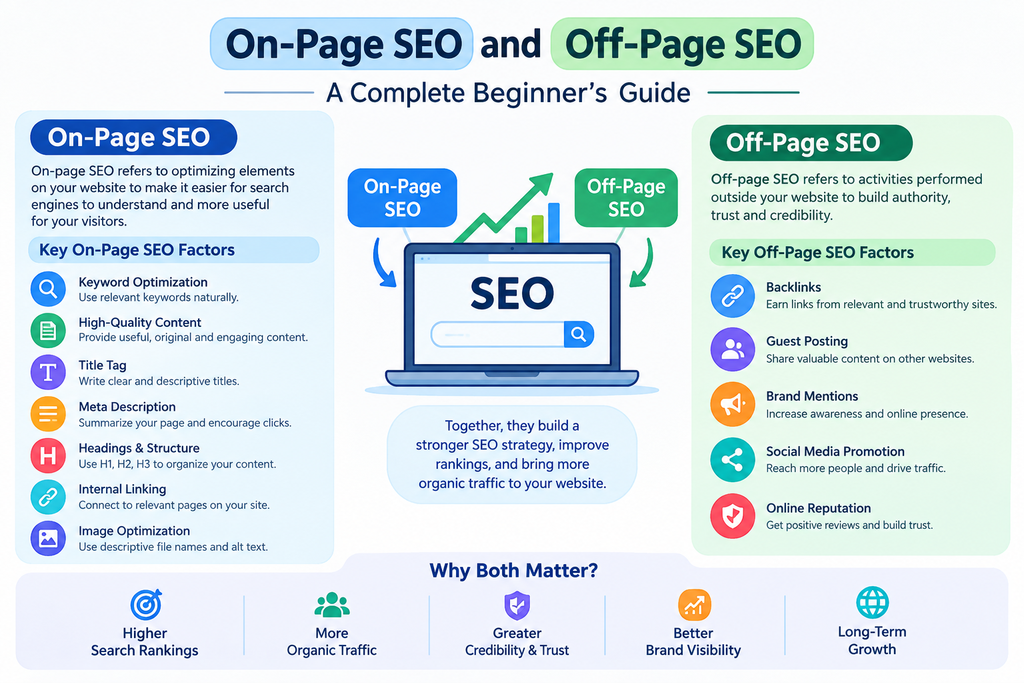
  • On-Page SEO and Off-Page SEO: A Complete Beginner’s Guide

    Search engine optimization (SEO) is important for helping websites appear in search engine results and attract the right audience. If you are new to SEO, two terms you will come across frequently are On-Page SEO and Off-Page SEO. Both are important parts of an effective SEO strategy, but they focus on different areas.

    On-page SEO focuses on optimizing elements that are present on your website, while off-page SEO focuses on activities performed outside your website to build authority and trust. Understanding both can help you create a stronger SEO strategy and improve your website’s visibility over time.

    What Is On-Page SEO?

    On-page SEO refers to the process of optimizing individual web pages to make them easier for search engines to understand and more useful for visitors. It includes elements such as content, keywords, headings, URLs, images, internal links, and meta tags.

    The main goal of on-page SEO is to help search engines understand what a page is about while providing a good experience for users.

    Important On-Page SEO Factors

    There are several elements you should consider when optimizing a webpage.

    1. Keyword Optimization

    Keywords are words or phrases people type into search engines. Using relevant keywords naturally throughout your content helps search engines understand the topic of your page.

    Your primary keyword should be included in important areas such as the title, introduction, headings where appropriate, URL, and meta description. However, avoid keyword stuffing because excessive or unnatural keyword use can make your content difficult to read.

    2. High-Quality Content

    Content is one of the most important parts of on-page SEO. Your content should provide useful, accurate, original, and relevant information that matches the search intent of your audience.

    Instead of writing content only for search engines, focus on answering the questions your readers are looking for. Use short paragraphs, examples, bullet points, and clear headings to improve readability.

    3. Title Tag

    The title tag tells search engines and users what a webpage is about. A good SEO title should be descriptive, relevant, and naturally include the primary keyword when appropriate.

    For example, a page targeting On-Page SEO and Off-Page SEO could use a title such as “On-Page SEO and Off-Page SEO: A Complete Beginner’s Guide.”

    4. Meta Description

    A meta description is a short summary of a webpage that can appear below the title in search results. It should explain what users can learn from the page and encourage relevant users to click.

    Including your main keyword naturally in the meta description can also help communicate the page’s relevance.

    5. Headings and Structure

    Use headings such as H1, H2, and H3 to organize your content. The H1 should clearly describe the main topic, while H2 and H3 headings can divide the article into smaller sections.

    A well-structured article makes it easier for both readers and search engines to understand the information.

    6. Internal Linking

    Internal links connect one page of your website to another page on the same website. They help visitors discover related content and can help search engines understand the relationship between different pages.

    For example, a blog about on-page SEO could internally link to another article about keyword research.

    7. Image Optimization

    Images can make your content more engaging, but they should also be optimized. Use descriptive file names, relevant alt text, and appropriately sized images.

    Alt text helps describe an image to users who cannot see it and can also provide search engines with additional context about the image.

    What Is Off-Page SEO?

    Off-page SEO refers to activities performed outside your website that can help improve its authority, reputation, and visibility. Unlike on-page SEO, these activities do not primarily involve changing the content or technical elements of your own webpage.

    One of the most commonly discussed parts of off-page SEO is link building.

    Important Off-Page SEO Factors

    1. Backlinks

    A backlink is a link from another website to your website. Quality backlinks can help search engines recognize that other websites find your content useful or relevant.

    However, the quality and relevance of backlinks are important. Building large numbers of low-quality or manipulative links can be harmful. Focus on earning links from relevant and trustworthy websites.

    2. Guest Posting

    Guest posting involves creating useful content for another relevant website and, where appropriate, receiving a link back to your website.

    The primary goal should be to provide valuable information to the audience rather than creating links purely for SEO.

    3. Brand Mentions

    When other websites, publications, or online communities mention your brand or website, it can help increase awareness and establish an online presence.

    Building a recognizable brand can support your overall SEO and marketing efforts.

    4. Social Media Promotion

    Sharing your content through social media can help more people discover it. Social media activity is not simply a replacement for SEO, but it can increase content visibility, generate traffic, and create opportunities for people to discover and reference your content.

    5. Online Reputation

    Your website’s reputation can influence how users perceive your business or brand. Positive reviews, useful content, genuine engagement, and consistent online information can contribute to a stronger online presence.

    On-Page SEO and Off-Page SEO: What Is the Difference?

    The main difference between On-Page SEO and Off-Page SEO is where the optimization takes place.

    On-page SEO focuses on elements you can control directly on your website, such as content, keywords, headings, URLs, images, internal links, and meta tags.

    Off-page SEO focuses on activities outside your website, such as earning backlinks, promoting content, building brand awareness, and developing relationships with relevant websites.

    Both approaches work together. A website may have strong content and good on-page optimization, but it can also benefit from building authority and visibility outside the website.

    Why Are On-Page SEO and Off-Page SEO Important?

    Using both approaches can create a more complete SEO strategy. On-page optimization helps search engines understand your content and helps visitors navigate and use your website.

    Off-page SEO can help establish credibility and increase your website’s exposure across the internet.

    For example, imagine you publish a detailed article about keyword research. You optimize the title, headings, keywords, images, URL, and internal links. This is on-page SEO.

    If another relevant website finds your article useful and naturally links to it, that is an example of an off-page SEO benefit.

    On-Page SEO and Off-Page SEO Best Practices

    When working on your SEO strategy, keep the following practices in mind:

    • Create useful and original content.
    • Research keywords before writing.
    • Use keywords naturally rather than stuffing them.
    • Write clear and descriptive SEO titles.
    • Create useful meta descriptions.
    • Organize content with headings.
    • Add relevant internal links.
    • Optimize images and alt text.
    • Make your website easy to navigate.
    • Focus on earning relevant, high-quality backlinks.
    • Promote useful content through appropriate channels.
    • Build genuine relationships with relevant websites and audiences.
    • Avoid manipulative link-building techniques.

    Conclusion

    On-Page SEO and Off-Page SEO are two important parts of a complete SEO strategy. On-page SEO helps optimize the content and elements of your website, while off-page SEO focuses on building authority, visibility, and recognition outside your website.

    For beginners, it is useful to work on both areas rather than focusing on only one. Start by creating helpful content, optimizing your pages, improving your website structure, and using relevant keywords naturally. Then gradually work on content promotion, brand awareness, and earning quality backlinks.

    SEO is a long-term process, so consistent improvement is more useful than trying to make every change at once. By combining effective on-page and off-page practices, you can create a stronger foundation for improving your website’s search visibility and attracting relevant organic traffic.