Search engine optimization (SEO) is important for helping websites appear in search engine results and attract the right audience. If you are new to SEO, two terms you will come across frequently are On-Page SEO and Off-Page SEO. Both are important parts of an effective SEO strategy, but they focus on different areas.
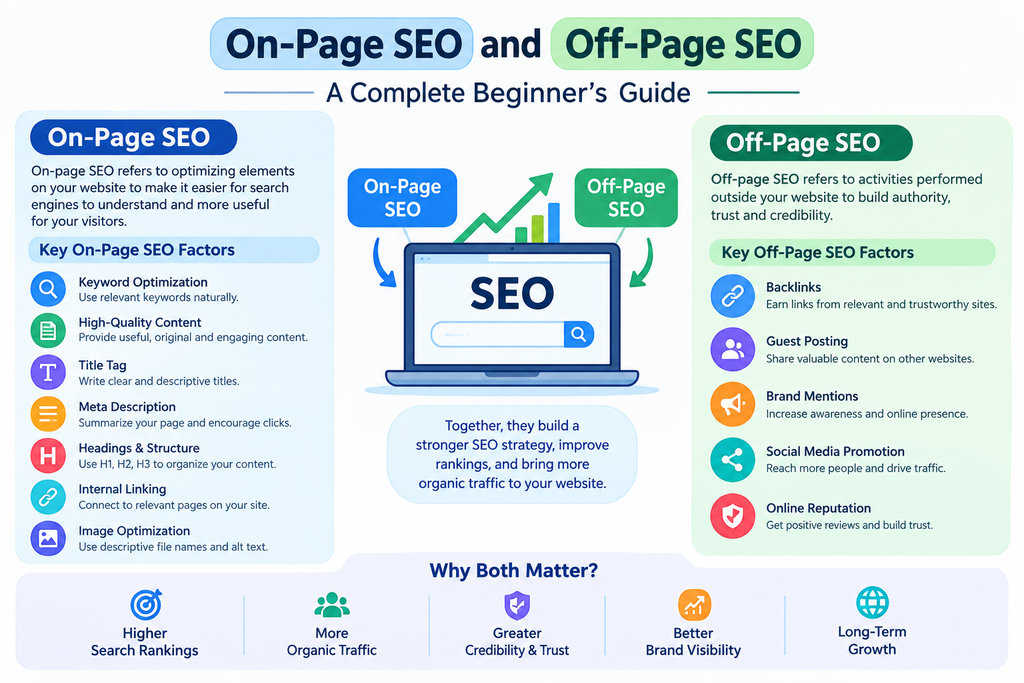
On-page SEO focuses on optimizing elements that are present on your website, while off-page SEO focuses on activities performed outside your website to build authority and trust. Understanding both can help you create a stronger SEO strategy and improve your website’s visibility over time.
What Is On-Page SEO?
On-page SEO refers to the process of optimizing individual web pages to make them easier for search engines to understand and more useful for visitors. It includes elements such as content, keywords, headings, URLs, images, internal links, and meta tags.
The main goal of on-page SEO is to help search engines understand what a page is about while providing a good experience for users.
Important On-Page SEO Factors
There are several elements you should consider when optimizing a webpage.
1. Keyword Optimization
Keywords are words or phrases people type into search engines. Using relevant keywords naturally throughout your content helps search engines understand the topic of your page.
Your primary keyword should be included in important areas such as the title, introduction, headings where appropriate, URL, and meta description. However, avoid keyword stuffing because excessive or unnatural keyword use can make your content difficult to read.
2. High-Quality Content
Content is one of the most important parts of on-page SEO. Your content should provide useful, accurate, original, and relevant information that matches the search intent of your audience.
Instead of writing content only for search engines, focus on answering the questions your readers are looking for. Use short paragraphs, examples, bullet points, and clear headings to improve readability.
3. Title Tag
The title tag tells search engines and users what a webpage is about. A good SEO title should be descriptive, relevant, and naturally include the primary keyword when appropriate.
For example, a page targeting On-Page SEO and Off-Page SEO could use a title such as “On-Page SEO and Off-Page SEO: A Complete Beginner’s Guide.”
4. Meta Description
A meta description is a short summary of a webpage that can appear below the title in search results. It should explain what users can learn from the page and encourage relevant users to click.
Including your main keyword naturally in the meta description can also help communicate the page’s relevance.
5. Headings and Structure
Use headings such as H1, H2, and H3 to organize your content. The H1 should clearly describe the main topic, while H2 and H3 headings can divide the article into smaller sections.
A well-structured article makes it easier for both readers and search engines to understand the information.
6. Internal Linking
Internal links connect one page of your website to another page on the same website. They help visitors discover related content and can help search engines understand the relationship between different pages.
For example, a blog about on-page SEO could internally link to another article about keyword research.
7. Image Optimization
Images can make your content more engaging, but they should also be optimized. Use descriptive file names, relevant alt text, and appropriately sized images.
Alt text helps describe an image to users who cannot see it and can also provide search engines with additional context about the image.
What Is Off-Page SEO?
Off-page SEO refers to activities performed outside your website that can help improve its authority, reputation, and visibility. Unlike on-page SEO, these activities do not primarily involve changing the content or technical elements of your own webpage.
One of the most commonly discussed parts of off-page SEO is link building.
Important Off-Page SEO Factors
1. Backlinks
A backlink is a link from another website to your website. Quality backlinks can help search engines recognize that other websites find your content useful or relevant.
However, the quality and relevance of backlinks are important. Building large numbers of low-quality or manipulative links can be harmful. Focus on earning links from relevant and trustworthy websites.
2. Guest Posting
Guest posting involves creating useful content for another relevant website and, where appropriate, receiving a link back to your website.
The primary goal should be to provide valuable information to the audience rather than creating links purely for SEO.
3. Brand Mentions
When other websites, publications, or online communities mention your brand or website, it can help increase awareness and establish an online presence.
Building a recognizable brand can support your overall SEO and marketing efforts.
4. Social Media Promotion
Sharing your content through social media can help more people discover it. Social media activity is not simply a replacement for SEO, but it can increase content visibility, generate traffic, and create opportunities for people to discover and reference your content.
5. Online Reputation
Your website’s reputation can influence how users perceive your business or brand. Positive reviews, useful content, genuine engagement, and consistent online information can contribute to a stronger online presence.
On-Page SEO and Off-Page SEO: What Is the Difference?
The main difference between On-Page SEO and Off-Page SEO is where the optimization takes place.
On-page SEO focuses on elements you can control directly on your website, such as content, keywords, headings, URLs, images, internal links, and meta tags.
Off-page SEO focuses on activities outside your website, such as earning backlinks, promoting content, building brand awareness, and developing relationships with relevant websites.
Both approaches work together. A website may have strong content and good on-page optimization, but it can also benefit from building authority and visibility outside the website.
Why Are On-Page SEO and Off-Page SEO Important?
Using both approaches can create a more complete SEO strategy. On-page optimization helps search engines understand your content and helps visitors navigate and use your website.
Off-page SEO can help establish credibility and increase your website’s exposure across the internet.
For example, imagine you publish a detailed article about keyword research. You optimize the title, headings, keywords, images, URL, and internal links. This is on-page SEO.
If another relevant website finds your article useful and naturally links to it, that is an example of an off-page SEO benefit.
On-Page SEO and Off-Page SEO Best Practices
When working on your SEO strategy, keep the following practices in mind:
- Create useful and original content.
- Research keywords before writing.
- Use keywords naturally rather than stuffing them.
- Write clear and descriptive SEO titles.
- Create useful meta descriptions.
- Organize content with headings.
- Add relevant internal links.
- Optimize images and alt text.
- Make your website easy to navigate.
- Focus on earning relevant, high-quality backlinks.
- Promote useful content through appropriate channels.
- Build genuine relationships with relevant websites and audiences.
- Avoid manipulative link-building techniques.
Conclusion
On-Page SEO and Off-Page SEO are two important parts of a complete SEO strategy. On-page SEO helps optimize the content and elements of your website, while off-page SEO focuses on building authority, visibility, and recognition outside your website.
For beginners, it is useful to work on both areas rather than focusing on only one. Start by creating helpful content, optimizing your pages, improving your website structure, and using relevant keywords naturally. Then gradually work on content promotion, brand awareness, and earning quality backlinks.
SEO is a long-term process, so consistent improvement is more useful than trying to make every change at once. By combining effective on-page and off-page practices, you can create a stronger foundation for improving your website’s search visibility and attracting relevant organic traffic.