When people search for something on Google, they usually have a specific reason for doing so. They may want to learn something, find a particular website, compare products, or make a purchase. Understanding this reason is known as search intent in SEO.
Search intent is an important part of keyword research and content optimization. If your content matches what users are actually looking for, it has a better chance of being useful and relevant to them. This can also help search engines understand the purpose of your page.
In this guide, we will explain what search intent means, the main types of search intent, why it matters for SEO, and how you can use it when creating content.
What Is Search Intent in SEO?
Search intent in SEO refers to the reason or purpose behind a user’s search query. It explains what the user expects to find when they enter a keyword into a search engine.
For example, consider these three searches:
- What is SEO?
- Best SEO tools
- Buy SEO software
Although all three are related to SEO, the user’s intention is different.
Someone searching “What is SEO?” is probably looking for information. A person searching “Best SEO tools” may be comparing different options. Someone searching “Buy SEO software” is showing a stronger purchasing intention.
Understanding these differences helps you create content that answers the right question.
Why Is Search Intent Important for SEO?
Search engines aim to provide users with results that are useful and relevant to their queries. Therefore, understanding search intent can help you create pages that better match what people expect.
For example, if someone searches for “how to create backlinks,” they probably want a guide or tutorial. Showing them a product page may not satisfy their needs.
Similarly, someone searching “best SEO tools for beginners” may want a comparison or list rather than a general definition of SEO.
By matching content with search intent, you can improve the relevance and usefulness of your pages.
The Four Main Types of Search Intent
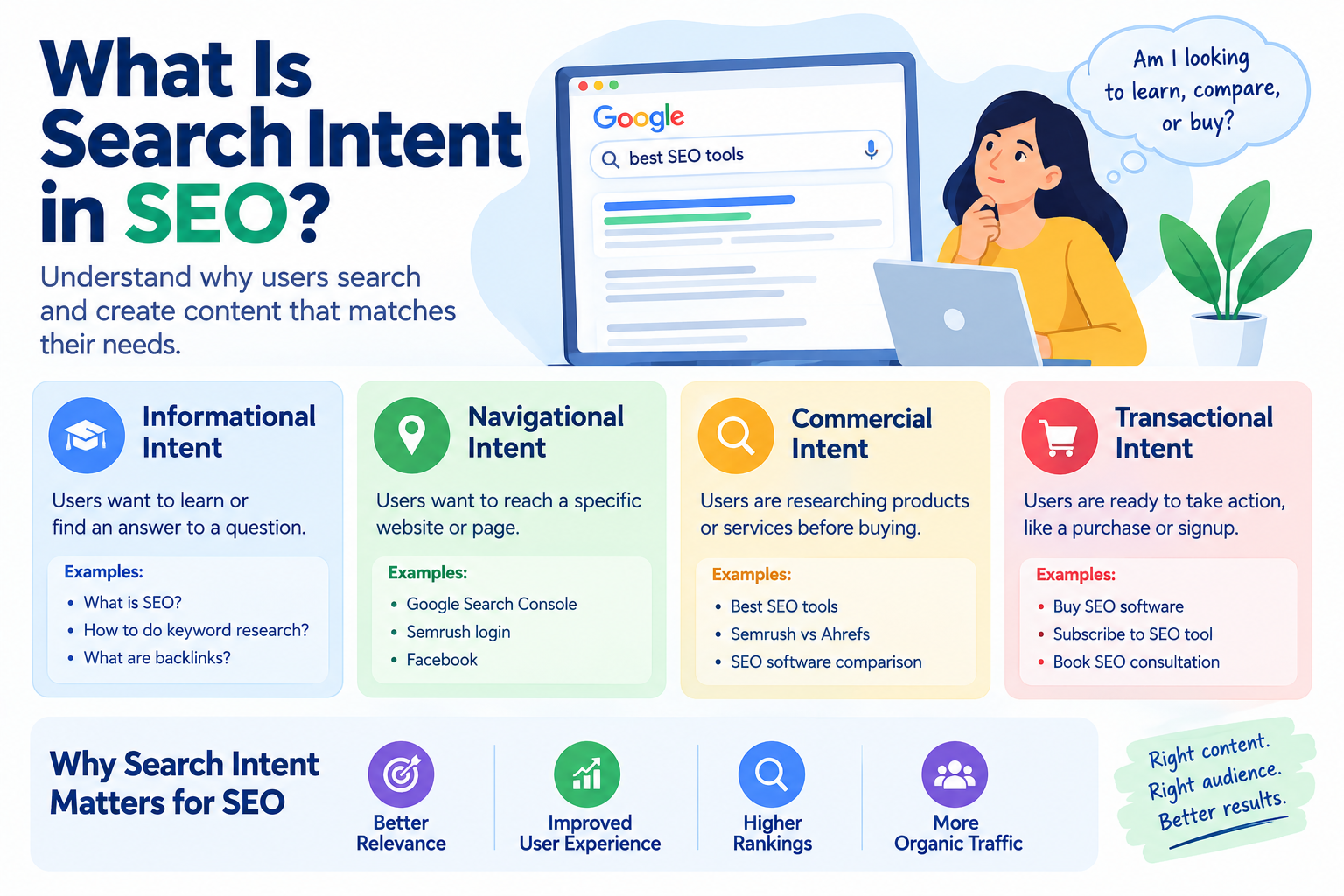
Search intent is commonly divided into four main categories: informational, navigational, commercial, and transactional.
1. Informational Search Intent
Informational intent occurs when users want to learn something or find an answer to a question.
Examples include:
- What is technical SEO?
- How does keyword research work?
- How to improve website traffic
- What are backlinks?
- What is search intent?
These searches are generally focused on gaining knowledge rather than immediately buying something.
Blog posts, tutorials, guides, FAQs, and educational articles are often suitable formats for informational searches.
If your website focuses on SEO education, many of your blog topics may target informational search intent.
2. Navigational Search Intent
Navigational intent occurs when a user is trying to reach a specific website, page, or online destination.
Examples include:
- Google Search Console
- Semrush login
- Canva
- YouTube
The user already has a particular destination in mind.
For businesses and websites, having a clear brand name, optimized website structure, and relevant pages can help users find the correct destination.
3. Commercial Search Intent
Commercial intent occurs when users are researching products, services, or solutions before making a decision.
Examples include:
- Best SEO tools
- Semrush vs Ahrefs
- Best keyword research tools for beginners
- SEO software comparison
- Best website analysis tools
These users may not be ready to purchase immediately, but they are evaluating available options.
Comparison articles, reviews, product guides, and detailed lists can work well for commercial investigation queries.
4. Transactional Search Intent
Transactional intent indicates that a user is ready to complete an action, often a purchase, signup, download, or subscription.
Examples include:
- Buy SEO software
- Subscribe to SEO tool
- Buy running shoes online
- Download SEO plugin
- Book SEO consultation
These searches are more action-oriented. Product pages, service pages, landing pages, and signup pages may be appropriate for transactional queries.
How to Identify Search Intent
Before creating content for a keyword, search for that keyword on Google.
Look at the pages appearing in the search results. Ask yourself what type of content dominates the results.
For example, if most results are detailed guides, the keyword probably has informational intent.
If most results are product pages, the query may have transactional intent.
You should also examine:
- Page titles
- Featured snippets
- People Also Ask questions
- Product results
- Videos
- Comparison pages
- Search result descriptions
The search results can provide useful clues about what Google considers relevant for that query.
Search Intent and Keyword Research
Keyword research should not focus only on search volume and keyword difficulty. Search intent should also be considered before selecting a target keyword.
Suppose you find a keyword with a high search volume. If the intent behind that keyword does not match your website or content, targeting it may not be useful.
For example, a website selling SEO services might find the keyword “what is SEO?” attractive because of its search volume. However, users searching that phrase are primarily looking for information rather than immediately looking for an SEO service.
A service page targeting that keyword may therefore not match the user’s expectations.
Choosing keywords based on both relevance and intent can make your content strategy more focused.
How to Create Content Based on Search Intent
Once you understand the intent behind a keyword, choose a content format that matches it.
For informational keywords, consider:
- Blog posts
- Tutorials
- Step-by-step guides
- FAQs
- Educational articles
For commercial keywords, consider:
- Comparisons
- Reviews
- Product lists
- Buying guides
For transactional keywords, consider:
- Product pages
- Service pages
- Landing pages
- Pricing pages
For navigational keywords, make sure your important brand and website pages are easy to find and clearly structured.
Search Intent and On-Page SEO
Search intent also affects how you optimize a page.
Your SEO title should clearly communicate what the page provides. Headings should organize the information logically, and the introduction should quickly address the user’s question.
For example, if your focus keyword is “how to do keyword research,” users are likely looking for a process or tutorial.
Your article should therefore provide clear steps rather than spending most of the content discussing the history of keywords.
Relevant internal links can also help users discover additional information related to their search.
Common Search Intent Mistakes
One common mistake is creating content without checking the current search results. A keyword may appear straightforward but have an intent that is different from what you expected.
Another mistake is trying to satisfy every possible intent on one page. A page should have a clear primary purpose.
Keyword stuffing is another problem. Repeating the same keyword excessively does not automatically make content more relevant. Instea