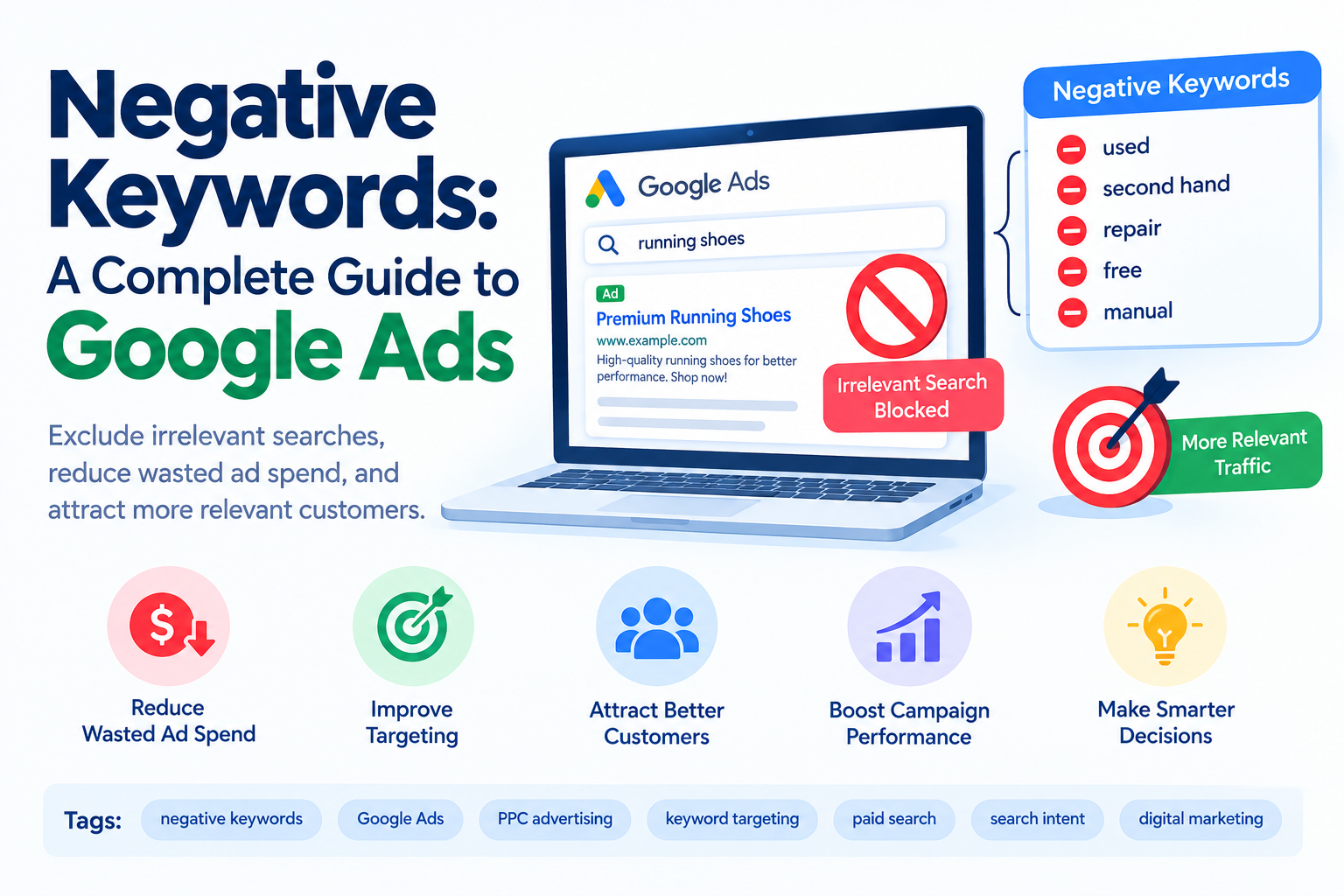
When running Google Ads, getting your advertisement in front of the right audience is important. However, it is equally important to prevent your ads from appearing for searches that are not relevant to your products or services. This is where negative keywords become useful.
Negative keywords allow advertisers to exclude specific search terms from their advertising campaigns. By preventing ads from showing for unwanted searches, businesses can improve targeting, reduce wasted ad spend, and focus their budget on more relevant potential customers.
What Are Negative Keywords?
Negative keywords are words or phrases added to an advertising campaign to prevent ads from being triggered by searches containing those terms.
For example, imagine you sell premium running shoes but do not sell used shoes. You might add “used” as a negative keyword. This can help prevent your advertisement from appearing when someone searches for “used running shoes.”
Negative keywords are mainly used in paid search advertising, particularly Google Ads. They help advertisers control which searches are relevant to their campaigns.
Why Are Negative Keywords Important?
Without proper keyword filtering, an advertisement may appear for searches that are related to your main keyword but do not match what you offer.
For example, a business selling paid online courses might target the keyword “SEO course.” However, people searching for “free SEO course” may not be interested in purchasing the course.
Adding “free” as a negative keyword could help the advertiser avoid spending money on clicks from users who are specifically looking for free resources.
This can make advertising campaigns more focused and help businesses use their advertising budget more efficiently.
How Negative Keywords Work
Google Ads uses keywords and search queries to determine when an advertisement may be eligible to appear.
Regular keywords tell Google which searches you want to target. Negative keywords work in the opposite direction by telling Google which searches you want to exclude.
For example, suppose your business sells new laptops and your target keyword is “buy laptops online.”
You might add negative keywords such as:
- used
- second hand
- repair
- free
- manual
This can help reduce exposure to searches that do not match your business offering.
However, negative keywords should be selected carefully. Adding overly broad exclusions can prevent your ads from reaching potentially valuable customers.
Types of Negative Keywords
Google Ads provides different ways to organize negative keyword targeting. Understanding these options can help advertisers create more precise campaigns.
Negative Broad Match
A negative broad match keyword can prevent an ad from showing when the search contains all of the negative keyword terms, depending on how the search is structured.
For example, if your negative keyword is “free SEO course,” searches containing the relevant terms may be excluded.
Advertisers should understand how negative matching differs from regular keyword matching before creating a large exclusion list.
Negative Phrase Match
Negative phrase match can be used when you want to exclude searches containing a particular phrase in the specified order.
For example, adding “free SEO course” as a negative phrase can help prevent ads from appearing for searches containing that phrase.
Negative Exact Match
Negative exact match provides more precise control. It can be useful when you want to exclude a particular search query without broadly excluding related searches.
For example, if you want to exclude the exact query “free SEO course,” you can use an exact negative keyword.
How to Find Negative Keywords
Finding negative keywords requires understanding what your target audience is actually searching for.
One useful method is checking the Google Ads Search Terms Report. This report shows the search queries that triggered your ads.
Look through the report and identify searches that:
- Are unrelated to your product
- Show the wrong search intent
- Attract users who cannot become customers
- Focus on free products when you sell paid products
- Relate to jobs when you sell a service
- Relate to tutorials when users are not looking to purchase
- Include products or services you do not offer
These searches can provide valuable negative keyword ideas.
Examples of Negative Keywords
The right negative keywords depend on your business, products, and campaign goals.
For example, an online store selling new products may consider terms such as:
- used
- second hand
- repair
- replacement
- free
A company offering paid professional services might consider:
- free
- DIY
- tutorial
- jobs
- salary
- training
However, these words should never be added automatically. A term such as “free” could sometimes be valuable if your business offers a free trial or free consultation.
Always consider the search intent before excluding a term.
Negative Keywords and Search Intent
Search intent describes the reason behind a user’s search.
Two searches can contain the same main keyword but have completely different intentions.
For example:
“buy SEO course”
and
“free SEO course”
Both searches contain “SEO course,” but the user’s intentions may be different. The first search indicates potential purchase intent, while the second may indicate that the person is looking for a free resource.
Negative keywords can help advertisers separate these different types of searches and focus their campaigns on the audience they want to reach.
Benefits of Using Negative Keywords
1. Reduce Wasted Ad Spend
When ads receive clicks from irrelevant searches, part of the advertising budget may be spent without reaching the intended audience. Negative keywords can reduce this type of unwanted traffic.
2. Improve Campaign Relevance
Excluding unrelated searches can make your advertising campaign more focused. Your ads can be shown to users whose searches are more closely connected to your products or services.
3. Improve Traffic Quality
Not every click has the same value. Negative keyword targeting can help reduce clicks from users who are unlikely to become customers.
4. Better Budget Management
A limited advertising budget needs to be used carefully. Excluding irrelevant searches can help businesses concentrate their spending on more relevant search queries.
5. Better Campaign Organization
Negative keywords can also help separate different campaigns or ad groups. For example, you may want one campaign to target informational searches and another to target purchase-focused searches.
Common Negative Keyword Mistakes
One common mistake is adding too many negative keywords without analyzing actual search data. This can unnecessarily restrict campaign reach.
Another mistake is ignoring the Search Terms Report. Regularly reviewing search queries can reveal new irrelevant terms that should be added to your negative keyword list.
It is also important to avoid confusing negative keywords with regular SEO keywords. Negative keywords are primarily an advertising targeting feature, while SEO keywords are terms used to help organic content appear in search results.
Finally, businesses should review their negative keyword lists regularly because customer behavior, products, and campaign goals can change over time.
How to Create a Negative Keyword List
Start by identifying searches that are clearly unrelated to your offer. Then review historical search data from your advertising campaigns.
Group similar exclusions together and decide whether they should apply to one ad group, one campaign, or multiple campaigns.
Before applying a negative keyword broadly, check whether it could accidentally exclude valuable searches.
For example, if you sell “free trial” software, adding “free” as a negative keyword could prevent relevant potential customers from seeing your ads.
Careful analysis is therefore more important than simply creating a long list of excluded terms.
Final Thoughts
Negative keywords are an important part of effective paid search advertising. They help advertisers prevent ads from appearing for irrelevant searches and can make campaign targeting more precise.
By reviewing search queries, understanding search intent, and regularly updating negative keyword lists, advertisers can reduce unwanted clicks and make better use of their advertising budget.
The goal is not to exclude as many searches as possible. Instead, the goal is to remove searches that do not match your products, services, or campaign objectives while keeping valuable opportunities available.
When combined with relevant keywords, compelling ad copy, strong landing pages, and regular campaign analysis, negative keyword management can become an important part of a well-structured Google Ads strategy.