If you are new to search engine optimization (SEO), finding the right tools can make your learning journey easier. SEO tools help you research keywords, analyze websites, improve content, monitor rankings, and understand how search engines work. However, many popular SEO platforms require a paid subscription, which can be difficult for beginners, students, and small website owners.
The good news is that several SEO tools free options are available to help you improve your website without spending a lot of money. These tools provide valuable insights into keyword research, on-page SEO, technical SEO, backlinks, and website performance.
In this guide, you will learn about the best free SEO tools, how to use them, and how they can support your website’s growth. Whether you are starting your first blog or managing a small business website, these tools can help you build a strong SEO foundation.
What Are SEO Tools?
SEO tools are online platforms or software that help website owners optimize their websites for search engines such as Google. They provide information about keywords, website performance, technical problems, competitors, and search visibility.
Search engine optimization involves several activities, including keyword research, content optimization, link building, and technical improvements. Instead of making decisions based only on assumptions, SEO tools help you understand what may be working and where improvements are needed.
For example, if you want to write a blog about “how to get backlinks,” a keyword research tool can help you discover related search terms. Similarly, Google Search Console can show how your website appears in Google Search results.
Some SEO tools are completely free, while others offer free plans with limited features. Choosing the right tool depends on your goals, experience, and website requirements.
Why Use Free SEO Tools?
Free SEO tools are particularly useful for beginners who want to learn SEO and improve their websites without making an immediate financial investment.
Learn SEO Without Spending Money
If you are a beginner, you may not want to purchase expensive SEO software before understanding how it works. Free tools allow you to practice keyword research, content optimization, and website analysis.
You can gradually learn different SEO techniques and decide whether you need advanced paid features later.
Find Relevant Keywords
Keyword research is an important part of SEO. It helps you understand what people search for on Google and other search engines.
Free keyword research tools can help you discover related keywords, search queries, and potential content ideas. This information can support your blog planning and content strategy.
Monitor Website Performance
Some tools help you understand how visitors find your website. You can check search impressions, clicks, indexing information, and other performance metrics.
These insights can help you identify opportunities to improve your content and search visibility.
Identify SEO Problems
Technical SEO tools can help you find issues such as broken links, indexing problems, missing metadata, and slow-loading pages.
Not every tool detects every issue, but they can make website analysis easier and more organized.
Best SEO Tools Free for Beginners
There are many SEO tools available online, but beginners should focus on platforms that provide practical information and are easy to understand.
Google Search Console
Google Search Console is a free service from Google that helps website owners monitor their website’s performance in Google Search.
It is one of the most useful tools for understanding how your website is appearing in search results.
Key Features:
- Monitor clicks and impressions
- Check average position and click-through rate (CTR)
- Identify search queries bringing visitors to your website
- Submit sitemaps
- Check indexing issues
- Review page indexing reports
- Inspect individual URLs
How to Use Google Search Console
First, add and verify your website in Google Search Console. Once your website is connected, Google will begin providing performance and indexing information as data becomes available.
Open the Performance report to check which keywords people use to find your website. You can also review which pages receive impressions and clicks.
For example, if you have written a blog about on-page SEO, Search Console may show search queries related to that topic. You can use these insights to improve your content and create related articles.
Best for: Website performance monitoring, indexing, and search query analysis.
Google Keyword Planner
Google Keyword Planner is a keyword research tool available through Google Ads. Although it is primarily designed for advertising campaigns, it can also help you discover keyword ideas for SEO.
The tool provides information about keyword search volume ranges, competition in Google Ads, and related keyword suggestions. Remember that advertising competition is not the same as organic SEO difficulty.
Key Features:
- Discover keyword ideas
- Explore related search terms
- Review historical search volume data
- Compare keyword trends
- Plan content topics based on search interest
How to Use Google Keyword Planner
Access Google Ads and open Keyword Planner. Choose the option to discover new keywords, then enter a topic related to your website.
For example, you could enter:
- SEO for beginners
- Keyword research
- On-page SEO
- Free SEO tools
- Website traffic
The tool will provide keyword suggestions that you can review for relevance.
When choosing keywords, consider search intent, relevance to your content, and the level of competition. Do not select a keyword only because it has a high search volume.
Best for: Keyword discovery and search volume research.
Google Trends
Google Trends is a free tool that helps you explore how search interest changes over time. It can be useful for discovering popular topics and comparing search terms.
Unlike some keyword research tools, Google Trends focuses on relative search interest rather than providing exact monthly search volume.
Key Features:
- Compare multiple search terms
- Explore search interest over time
- Identify seasonal trends
- Discover related topics and queries
- Review regional search interest
How to Use Google Trends for SEO
Suppose you want to write an article about SEO tools. You can compare terms such as “SEO tools,” “keyword research,” and “SEO audit.”
The results can help you understand whether interest in a topic is increasing, decreasing, or changing seasonally.
You can also use Google Trends to identify content opportunities. However, search interest alone does not guarantee that a keyword will generate website traffic.
Best for: Topic research, trend analysis, and content planning.
Google PageSpeed Insights
Website speed and user experience are important considerations when optimizing a website. Google PageSpeed Insights is a free tool that analyzes the performance of individual web pages.
It provides performance measurements and recommendations for improving page loading and user experience.
Key Features:
- Analyze mobile and desktop performance
- Review Core Web Vitals
- Identify performance opportunities
- Check loading-related issues
- Review accessibility and other audit categories
How to Use PageSpeed Insights
Visit PageSpeed Insights and enter your website URL. The tool will generate a report for the selected page.
Review the recommendations and prioritize practical improvements. Common suggestions may include optimizing images, reducing unnecessary scripts, and improving resource loading.
Best for: Website performance and page speed analysis.
Google Rich Results Test
The Google Rich Results Test helps you check whether a web page’s structured data may be eligible for certain rich results in Google Search.
Structured data is a type of code that provides search engines with information about the content of a page.
Key Features:
- Test supported structured data
- Identify structured data errors
- Review detected rich result types
- Understand potential eligibility for supported search features
Enter a page URL or paste supported structured data into the testing tool. Review the results to identify errors or warnings.
Remember that passing the test does not guarantee that Google will display a rich result.
Best for: Structured data testing and technical SEO learning.
Bing Webmaster Tools
Bing Webmaster Tools is a free platform that helps website owners monitor their websites in Bing search.
Although many beginners focus primarily on Google, Bing also provides webmaster tools that can help with website analysis.
Key Features:
- Monitor search performance
- Submit sitemaps
- Review site scan information
- Identify SEO issues
- Explore available keyword and backlink information
Sign in to Bing Webmaster Tools and add your website. Follow the verification process and explore the available reports.
Best for: Bing search monitoring and website diagnostics.
Ahrefs Webmaster Tools
Ahrefs offers Webmaster Tools for eligible verified websites, providing access to selected website analysis features.
Ahrefs is widely known for its SEO research platform, and its webmaster offering can help website owners examine technical SEO issues and backlink information.
Key Features:
- Website audits
- Technical SEO issue identification
- Backlink-related insights
- Site health information
- Selected website analysis features
Create an account and verify ownership of your website using one of the available verification methods. Once access is established, review the audit reports and prioritize relevant issues.
Free access may have limitations, so check the current plan details before relying on a specific feature.
Best for: Technical website audits and backlink-related research.
Ubersuggest
Ubersuggest is an SEO research tool that provides keyword ideas, content research, and website analysis features. Its free access is subject to usage limits and plan restrictions.
It can be useful for beginners who want to explore related keywords and understand the basic concepts of SEO research.
Key Features:
- Keyword suggestions
- Keyword overview data
- Content ideas
- Website analysis
- Selected backlink information
Enter a keyword related to your blog topic and review the available suggestions. Compare related phrases and consider which ones match your audience’s search intent.
For example, if your main keyword is “SEO tools free,” you might explore related topics such as:
- Free keyword research tools
- Best SEO tools for beginners
- Free website audit tools
- SEO tools for small websites
Use these suggestions to plan useful content rather than inserting every keyword into the same article.
Best for: Keyword ideas and beginner-friendly SEO research.
What Are LSI Keywords in SEO?
LSI stands for Latent Semantic Indexing. In modern SEO discussions, the phrase “LSI keywords” is commonly used to describe related terms and semantically relevant phrases.
Google does not provide an official SEO feature called “LSI keywords” that you must target to rank. Instead, focus on creating comprehensive content that naturally covers related concepts.
For example, if your focus keyword is “SEO tools free,” relevant related terms may include:
- Free SEO tools for beginners
- Keyword research tools
- Website audit tools
- Technical SEO tools
- Google Search Console
- Search engine optimization
- SEO performance analysis
- On-page SEO
- Backlink analysis
- Website traffic
These terms help you explain the topic in greater detail and address related user questions.
How to Choose the Right Free SEO Tool
With so many tools available, beginners may feel confused about which one to use. The best approach is to choose tools according to your specific SEO task.
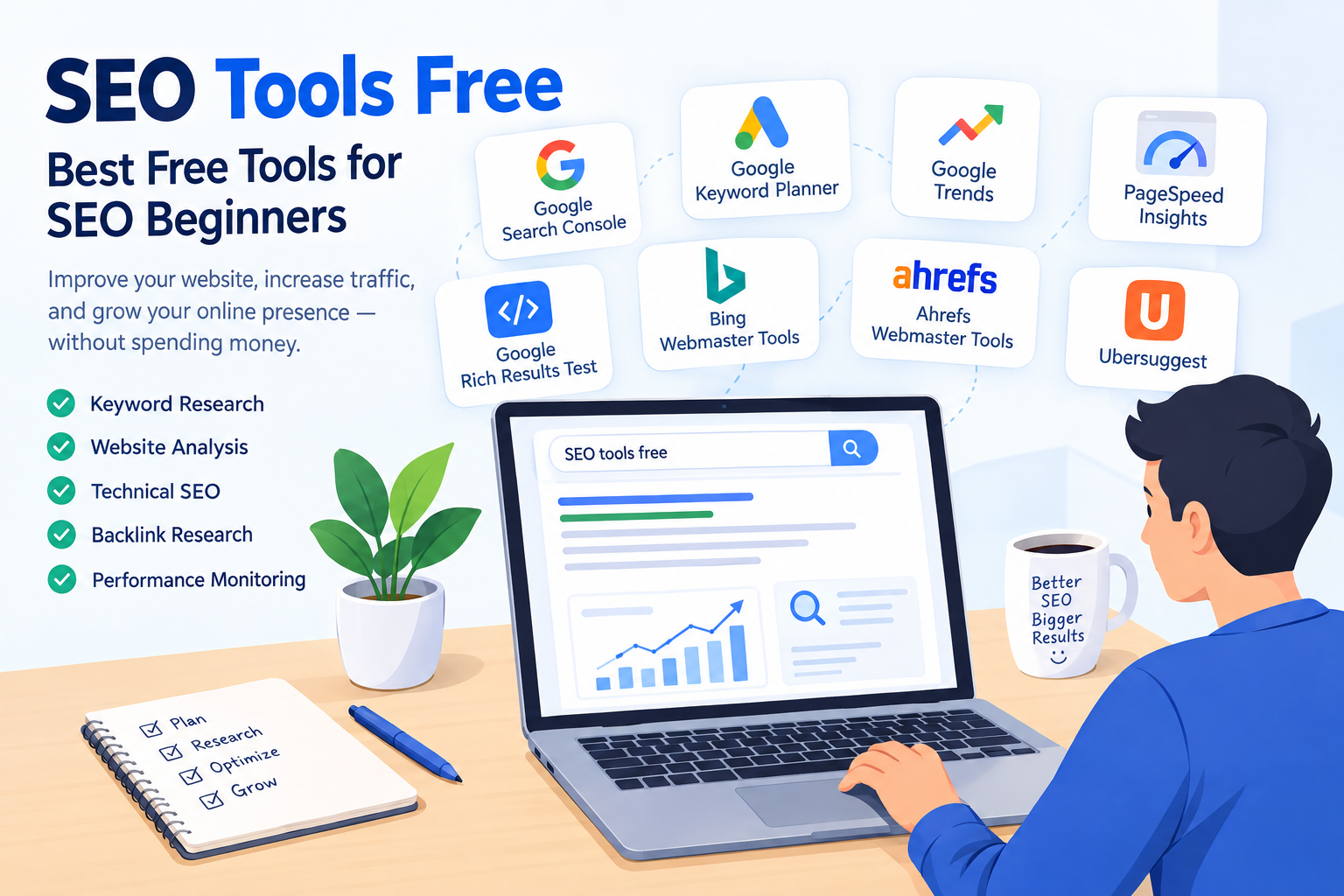
Search performance: Google Search Console
Keyword ideas: Google Keyword Planner
Search trends: Google Trends
Page performance: PageSpeed Insights
Structured data: Rich Results Test
Bing performance: Bing Webmaster Tools
Website audit: Ahrefs Webmaster Tools
Keyword research: Ubersuggest
The availability of features and usage limits can change, so review the official tool websites for current access details.
How to Use Free SEO Tools for Your Blog
Step 1: Find a Relevant Topic
Start by selecting a topic related to your website niche. Use Google Trends or Google Keyword Planner to explore search interest and keyword ideas.
Choose a topic that is relevant to your audience and that you can explain clearly.
Step 2: Research Keywords
Find a primary keyword that represents the main topic of your article. Then identify related keywords that help you cover important subtopics.
Primary keyword: SEO tools free
Related keywords:
- Free SEO tools for beginners
- Best keyword research tools
- Free technical SEO tools
- Website performance tools
Check the search intent behind your keywords before creating the content.
Step 3: Create Useful Content
Write an informative article that answers the reader’s questions. Include a clear introduction, organized headings, examples, and practical recommendations.
Use your focus keyword naturally in important locations, such as the title, introduction, and relevant headings where appropriate.
Avoid repeating the same keyword in every paragraph.
Step 4: Optimize On-Page SEO
Review the main on-page SEO elements, including:
- SEO title
- Meta description
- URL structure
- Heading hierarchy
- Internal links
- Image alt text
- Content readability
These elements help organize your content and improve the experience for visitors.
Step 5: Monitor Your Website
After publishing your article, use Google Search Console to monitor its performance as data becomes available.
Look at impressions, clicks, and search queries. If your page receives impressions but few clicks, review whether the title and meta description accurately communicate the value of your content.
Do not expect immediate results. SEO performance can take time and depends on factors such as competition, content quality, website authority, and search engine crawling.
Common SEO Mistakes Beginners Should Avoid
Focusing Only on Search Volume
A keyword with high search volume is not always the best choice for a new website. Consider relevance, search intent, competition, and whether you can create content that satisfies the query.
Stuffing Keywords
Repeating a keyword excessively can make your content difficult to read. Use the primary keyword naturally and include related terms only when they add value.
Ignoring Search Intent
Before writing an article, understand what the user wants. Someone searching for “how to use Google Search Console” may need a step-by-step guide, while someone searching for “Google Search Console” may be looking for the official tool.
Create content that matches the purpose of the search.
Expecting Instant Results
Publishing an article does not guarantee immediate rankings or traffic. Search engines need to discover and process content, and ranking performance varies between websites and queries.
Monitor progress and improve your content over time.
Using Too Many Tools at Once
Beginners sometimes try to use every SEO platform available. This can make learning confusing.
Start with a few tools, understand their reports, and gradually add more as your SEO knowledge improves.
Frequently Asked Questions About Free SEO Tools
Can I do SEO without paying for tools?
Yes. You can perform many basic SEO tasks using free tools, including keyword research, website performance monitoring, indexing checks, and technical diagnostics. Paid tools may provide additional data or advanced features, but they are not required for learning SEO.
Which free SEO tool is best for beginners?
The most useful tool depends on your task. Google Search Console is valuable for monitoring your website’s Google Search performance, while Google Keyword Planner and Google Trends can support keyword and topic research.
Are free SEO tools accurate?
Free SEO tools can provide useful information, but the accuracy and coverage of their data vary. Search volume estimates, keyword difficulty scores, and traffic estimates are not guaranteed to reflect exact results. Use multiple relevant signals and interpret the data carefully.
How long does SEO take to show results?
There is no fixed time for SEO results. Some pages may begin receiving impressions relatively quickly, while meaningful growth can take much longer. Results depend on the website, topic, competition, content quality, and other factors.
Do I need paid SEO tools for a new blog?
Not necessarily. A new blogger can learn and practice SEO using free tools. As your website grows, you can evaluate whether paid tools would provide enough additional value for your goals.
Conclusion
Free SEO tools are useful resources for beginners who want to learn search engine optimization and improve their websites. Tools such as Google Search Console, Google Keyword Planner, Google Trends, and PageSpeed Insights can support different stages of the SEO process.
Instead of relying on a single platform, use tools according to your goals. Research relevant keywords, create useful content, optimize your pages, and monitor your website’s performance over time.
The most important part of SEO is not simply using the largest number of tools. It is learning how to interpret information and apply practical improvements to your website.
Start with the free SEO tools that match your needs, build your knowledge consistently, and use the insights to create a better website for your audience.