Understanding the SEO SEM difference is important for anyone learning digital marketing, website optimization, or online business promotion. Both SEO and SEM help websites reach people through search engines such as Google, but they use different approaches to attract visitors.
SEO focuses on improving organic search visibility, while SEM is commonly used in modern marketing to describe paid search advertising. Both strategies can support a website’s marketing goals, depending on its budget, audience, and business objectives.
In this blog, we will explain the SEO SEM difference, how both strategies work, their benefits, key metrics, and how beginners can use them to improve their digital marketing knowledge.
What Is SEO?
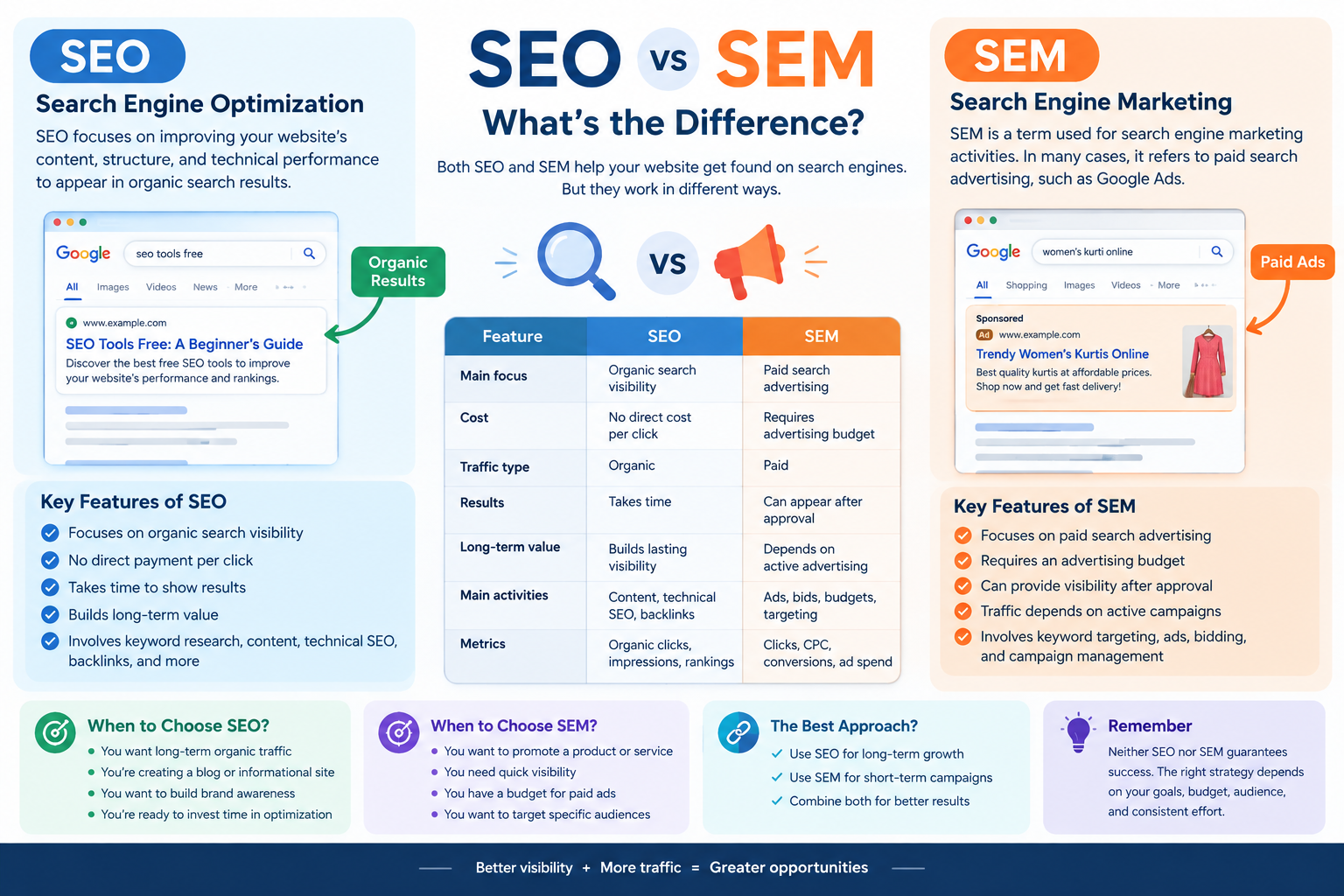
SEO stands for Search Engine Optimization. It is the process of improving a website’s content, structure, and technical performance to help its pages appear in organic search results.
Organic search results are unpaid listings displayed by search engines when users search for information, products, or services.
For example, if someone searches for “how to get backlinks,” Google may display blog posts explaining backlink-building strategies. Website owners use SEO techniques to make their content relevant, useful, and accessible to search engines and users.
How Does SEO Work?
SEO involves several activities that help improve website visibility. These include:
- Keyword research: Finding words and phrases that users search for.
- On-page SEO: Optimizing titles, headings, content, and internal links.
- Technical SEO: Improving website crawlability, indexing, and technical performance.
- Off-page SEO: Building relevant external references and backlinks.
- Content optimization: Creating helpful content that matches search intent.
SEO does not guarantee a specific ranking or a fixed amount of traffic. Search engine algorithms, competition, content quality, and many other factors influence organic visibility.
Example of SEO
Imagine you create a blog titled “SEO Tools Free: A Beginner’s Guide.”
You can optimize the article by researching relevant keywords, writing useful information, creating an appropriate meta title, adding internal links, and improving the website’s technical structure.
Over time, search engines may discover and rank the article for relevant searches. The timeline and results will vary depending on your website and the level of competition.
What Is SEM?
SEM stands for Search Engine Marketing. The term can have a broad meaning that includes search engine marketing activities such as SEO and paid search advertising. However, in many modern digital marketing contexts, SEM is commonly used to refer specifically to paid search advertising.
Paid search advertising allows businesses to display sponsored advertisements in search engine results for relevant queries. Google Ads is one example of a platform used for this purpose.
Advertisers generally pay according to the campaign’s billing model, such as cost per click, and compete through an advertising auction.
How Does SEM Work?
A paid search campaign commonly involves the following steps:
- Identify relevant keywords and target audiences.
- Create advertisements related to the product or service.
- Set a budget and campaign settings.
- Choose relevant landing pages.
- Monitor clicks, costs, and conversions.
- Optimize the campaign based on performance.
Paid ads may appear quickly after approval and when the campaign meets eligibility requirements. However, visibility, traffic, and conversions are not guaranteed.
Example of SEM
Suppose you own a clothing business and sell women’s kurtis online. You could create a Google Ads campaign targeting searches such as “buy women’s kurti online.”
Your advertisement may appear in sponsored search results when it is eligible to participate in the relevant auction. You can then measure the campaign’s clicks, advertising costs, and purchases.
This is an example of paid search marketing.
SEO SEM Difference: Key Comparison
Understanding the SEO SEM difference becomes easier when comparing the two strategies across important factors.
| Feature | SEO | SEM (Paid Search) |
|---|---|---|
| Main focus | Organic search visibility | Paid search advertising |
| Cost | No direct payment per organic click | Requires an advertising budget |
| Traffic type | Organic | Paid |
| Results | Usually take time to develop | Can provide paid visibility after campaign approval |
| Long-term value | Can build lasting organic visibility | Traffic typically depends on active advertising |
| Main activities | Content, technical SEO, backlinks | Ads, bids, budgets, targeting |
| Performance metrics | Organic clicks, impressions, rankings | Clicks, CPC, conversions, ad spend |
The definition of SEM can vary. Some marketing resources use SEM as an umbrella term for search engine marketing, while others use it mainly for paid search. Clarifying the terminology is important when studying SEO or working with marketing professionals.
Benefits of SEO
SEO provides several potential benefits for website owners and businesses.
1. Builds Organic Visibility
SEO helps your website compete for relevant unpaid search results. When your content matches users’ search intent and meets search engine quality requirements, it may gain organic visibility.
2. Supports Long-Term Content Growth
A useful blog can continue attracting organic visitors after publication. However, traffic may change over time because of competition, algorithm updates, and changing search behavior.
3. Improves Website Structure
SEO encourages better navigation, internal linking, mobile usability, and technical accessibility. These improvements can benefit both users and search engines.
4. Supports Brand Awareness
Appearing in relevant organic search results can help users discover your website and become familiar with your brand.
Benefits of SEM
Paid search advertising provides a different set of potential benefits.
1. Quick Access to Paid Visibility
Once a campaign is approved and eligible, advertisements can begin appearing for relevant searches. The exact timing depends on the platform and campaign setup.
2. Targeted Advertising
Advertisers can use available targeting options, such as location, language, and search-related signals, to reach selected audiences.
3. Measurable Results
Paid advertising platforms provide data about impressions, clicks, costs, and conversions. This information helps businesses evaluate campaign performance.
4. Budget Management
Advertisers can set campaign budgets and adjust bids and settings according to their goals. Actual spending and results depend on the campaign’s configuration and auction conditions.
SEO vs SEM: Which Should You Choose?
The right strategy depends on your website’s purpose, budget, timeline, and target audience. SEO and SEM can also be used together.
SEO May Be Useful When:
- You want to build organic search visibility.
- You are developing an informational blog.
- You want to improve website content and structure.
- You are prepared to invest time in long-term optimization.
SEM May Be Useful When:
- You want to advertise a product or service.
- You have a budget for paid search campaigns.
- You want to test specific search audiences.
- You need to measure paid advertising performance.
For example, an online clothing store may use SEO to publish styling guides and attract organic visitors while using paid search ads to promote selected products.
Neither strategy guarantees business success. Results depend on execution, competition, user demand, and the quality of the website or campaign.
Important SEO Metrics
If you are learning SEO, understanding performance metrics will help you evaluate your work.
Organic Clicks
Organic clicks show how many times users visit your website through unpaid search results. Google Search Console provides information about organic search clicks.
Impressions
Impressions indicate how often your website’s search results are displayed. A high number of impressions does not necessarily mean users will click on your page.
Average Position
Average position is a Search Console metric that summarizes the average position of your site’s search results for reported queries. It should be interpreted carefully because search results vary by query and context.
Organic Traffic
Organic traffic refers to visitors who arrive at your website through unpaid search results. Analytics tools can help you monitor this traffic.
Important SEM Metrics
Paid search campaigns use different performance indicators to measure results.
Cost Per Click (CPC)
CPC refers to the cost associated with a click on an advertisement. The actual amount depends on the advertising platform and campaign billing details.
Click-Through Rate (CTR)
CTR measures the percentage of impressions that result in clicks.
For example, if an advertisement receives 10 clicks from 100 impressions, its CTR is 10%.
Conversions
A conversion is a desired action, such as purchasing a product, submitting a form, or signing up for a service.
Ad Spend
Ad spend is the amount of money spent on a paid advertising campaign. Tracking spending helps advertisers compare campaign costs with their business objectives.
Common Mistakes Beginners Should Avoid
When learning SEO and SEM, avoid assuming that either strategy guarantees immediate results.
Some common mistakes include:
- Expecting SEO rankings to improve instantly.
- Running paid advertisements without a clear objective.
- Ignoring the relevance of keywords.
- Focusing only on traffic instead of meaningful conversions.
- Using misleading titles or advertisements.
- Failing to monitor campaign performance.
A clear strategy and regular evaluation can help you make more informed marketing decisions.
How to Learn SEO and SEM
If you are a beginner, start by building a strong foundation in SEO. Learn keyword research, on-page optimization, technical SEO, and content writing.
After understanding organic search, explore paid advertising concepts such as Google Ads, keyword targeting, bidding, campaign budgets, and conversion tracking.
You can practice by creating a sample website or improving your own blog. Use Google Search Console to learn about organic search performance and explore official Google Ads learning resources to understand paid advertising.
Combining theoretical knowledge with practical exercises can help you develop useful digital marketing skills.
Conclusion
The SEO SEM difference mainly relates to how websites gain visibility through search engines. SEO focuses on organic search optimization, while SEM is commonly used to describe paid search advertising, although the terminology can vary.
SEO supports content development, website optimization, and organic visibility. SEM can help businesses promote products and services through paid advertisements and measure campaign performance.
As you continue learning digital marketing, understanding both strategies will help you create a more complete approach to website promotion. Focus on useful content, relevant keywords, clear goals, and consistent performance analysis to develop your SEO and SEM skills.