Keywords are an important part of SEO, but creating optimized content is not simply about repeating the same keyword again and again. Search engines can understand the overall topic and context of a page, which means content should cover related concepts naturally. This is where the term LSI keywords often comes into SEO discussions.
You may have heard that using LSI keywords can improve rankings, but there is some confusion around what the term actually means. In modern SEO, people commonly use “LSI keywords” to describe words and phrases that are semantically related to a main topic. However, Google’s search systems do not use “LSI keywords” as a specific ranking factor.
Understanding this difference can help you use related keywords more effectively without keyword stuffing.
What Are LSI Keywords?
What Are LSI Keywords? In SEO discussions, LSI keywords generally refers to words and phrases that are related to the main topic of a webpage.
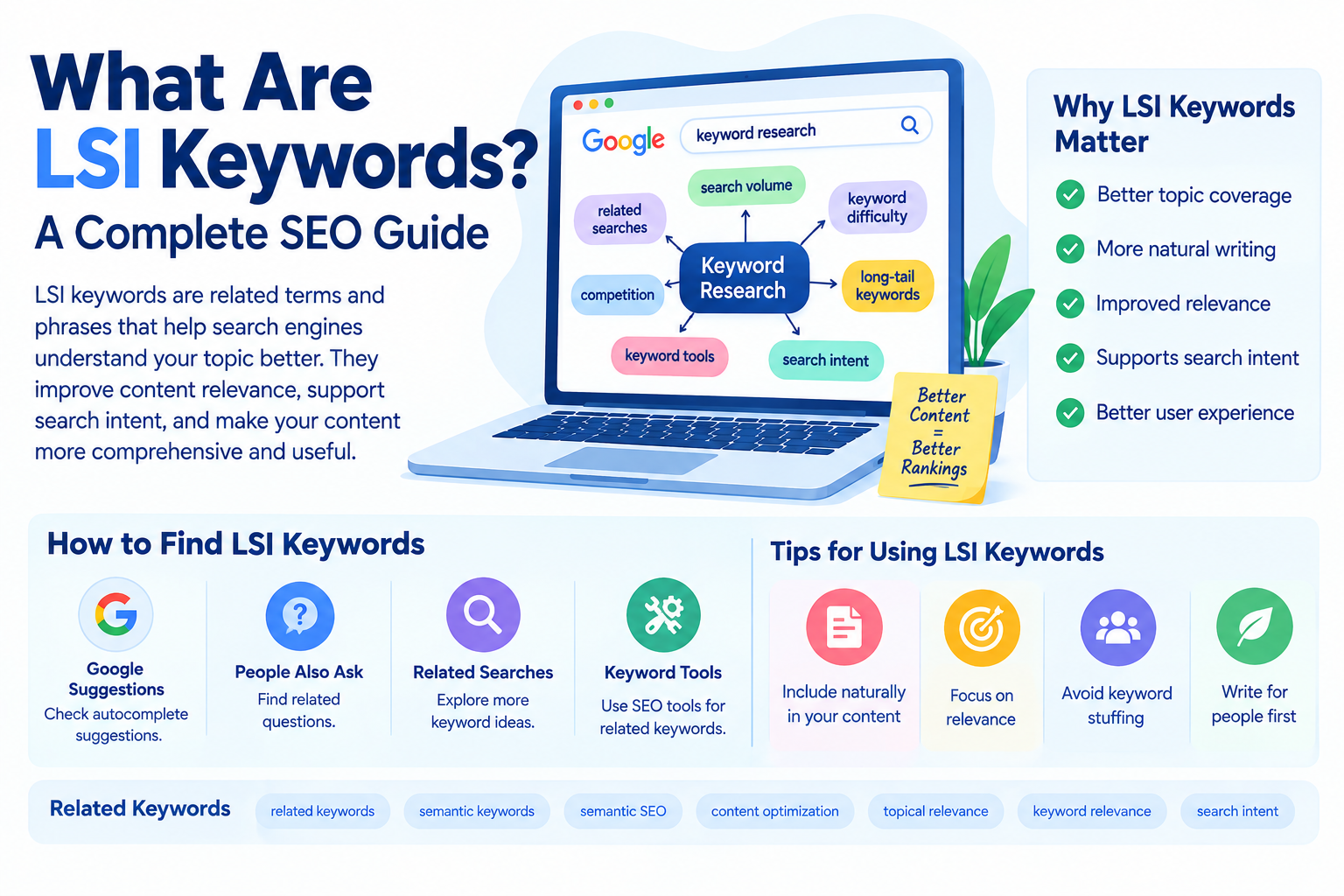
For example, if your main topic is “keyword research,” related terms might include:
- search volume
- keyword difficulty
- search intent
- long-tail keywords
- keyword research tools
- competition
- related searches
These terms help provide context around the main topic.
The phrase “LSI” comes from Latent Semantic Indexing, a mathematical technique developed for analyzing relationships between words and documents. However, there is no good evidence that Google uses LSI as a specific SEO ranking system.
Therefore, it is more accurate to think of LSI keywords as related or semantically relevant terms rather than a special type of Google ranking keyword.
Why Are Related Keywords Important for SEO?
Search engines have become better at understanding the meaning and context of content. A well-written article naturally includes words and concepts that are connected to its main subject.
For example, an article about technical SEO might naturally discuss:
- crawlability
- indexing
- XML sitemaps
- robots.txt
- Core Web Vitals
- website speed
- mobile optimization
These terms help demonstrate that the article covers different aspects of technical SEO.
The goal is not to insert as many related keywords as possible. Instead, include relevant concepts when they genuinely help explain the topic.
LSI Keywords vs Primary Keywords
Your primary keyword is the main search phrase you want a page to target.
For example:
Primary keyword: keyword research
Related terms could include:
- keyword research tools
- search volume
- keyword difficulty
- long-tail keywords
- search intent
The primary keyword gives your content its main focus, while related terms help you cover the subject more completely.
A strong SEO article can use both without making the content sound repetitive.
How to Find LSI Keywords
Although “LSI keywords” is a common SEO term, you can find related and semantic keywords using several practical methods.
Google Search Suggestions
Start typing your main keyword into Google and look at the autocomplete suggestions.
For example, searching for “SEO tools” may produce suggestions related to free SEO tools, SEO tools for beginners, or SEO analysis tools.
These suggestions can provide ideas for related topics and search queries.
People Also Ask
The People Also Ask section can provide questions related to your main topic.
If your article is about keyword research, you may find questions such as:
- What is keyword research?
- Why is keyword research important?
- How do I find keywords?
- Which keyword research tools are useful?
These questions can help you identify related concepts to include in your content.
Related Searches
At the bottom of Google’s search results, you may find related searches. These can reveal additional phrases connected to your topic.
Use them as content research ideas rather than trying to insert every phrase into your article.
Keyword Research Tools
SEO platforms can provide related keywords and keyword variations based on your main topic.
When researching related terms, consider:
- Relevance
- Search intent
- Search volume
- Competition
- Topic connection
Not every suggested keyword needs to be used. Select terms that genuinely contribute to the content.
How to Use LSI Keywords in Content
The best way to use related keywords is naturally.
Suppose your primary keyword is “on-page SEO.” Your article might naturally discuss:
- title tags
- meta descriptions
- heading structure
- internal links
- image alt text
- keyword placement
- URL optimization
These concepts are relevant because they are important parts of on-page SEO.
You can include related terms in headings, paragraphs, examples, lists, image descriptions, and other appropriate areas.
However, avoid forcing a keyword into a sentence simply because you want to include it.
LSI Keywords and Search Intent
Search intent is another important part of semantic SEO.
Search intent describes why someone enters a particular query into a search engine. A user may want information, navigate to a website, compare options, or make a purchase.
For example, someone searching “what is technical SEO” is probably looking for an explanation. Someone searching “best technical SEO tools” may be researching tools.
Related keywords should support the intent behind the main query.
If your content targets an informational keyword, related questions and explanatory terms can help you provide a more complete answer.
Benefits of Using Related Keywords
1. Better Topic Coverage
Related terms can help you cover different aspects of a subject instead of discussing only one narrow part of it.
2. More Natural Writing
Using relevant variations can prevent excessive repetition of your exact primary keyword.
Instead of repeating “keyword research” in every sentence, you can naturally discuss search queries, search volume, keyword difficulty, and keyword tools.
3. Improved Relevance
Relevant concepts provide additional context about your page. This can make it easier for both readers and search engines to understand the subject.
4. Better User Experience
A comprehensive article can answer related questions that users may have after reading the main topic.
This can make the content more useful and informative.
Common Mistakes With LSI Keywords
One major mistake is believing that there is a fixed list of LSI keywords that Google expects you to use. There is no official Google list of “LSI keywords” that guarantees rankings.
Another mistake is keyword stuffing. Adding related terms repeatedly can make your article unnatural and difficult to read.
You should also avoid adding unrelated keywords simply because a keyword tool suggests them. Relevance is more important than the number of keywords included.
Finally, do not focus so heavily on keywords that you forget the reader. Content should answer questions clearly and provide useful information.
LSI Keywords and Keyword Density
Keyword density refers to how frequently a keyword appears in a piece of content.
There is no ideal keyword density that guarantees higher Google rankings. Repeating a keyword excessively can make content sound unnatural.
Instead of calculating how many times a related term should appear, focus on covering the topic naturally.
For example, if you are writing about keyword research and need to explain search volume, mention it where the concept is relevant. There is no need to repeat “search volume” in every paragraph.
LSI Keywords and Semantic SEO
Semantic SEO focuses on the meaning, relationships, and context surrounding a topic.
Instead of optimizing a page for only one phrase, you can create content that comprehensively covers the subject.
For example, an article about backlinks could naturally discuss:
- link building
- referring domains
- backlink quality
- anchor text
- internal links
- external links
- link authority
These related concepts can help create a more complete resource about backlinks.
Final Thoughts
What Are LSI Keywords? The term is commonly used in SEO to describe words and phrases that are semantically related to a main topic. Although LSI itself is not a known Google ranking factor, using relevant related terms can help you create comprehensive and natural content.
Focus on your primary keyword, understand search intent, research related concepts, and include them where they genuinely add value. Avoid keyword stuffing and do not try to use every related phrase you discover.
The best approach is to write for people first while making your topic, purpose, and important concepts clear. When your content is relevant, useful, well-structured, and comprehensive, related keywords become a natural part of good SEO writing.